


Professional Watch Servicing Myths: What Every Owner Should Know in 2026

Your favorite mechanical watch might still be ticking perfectly, but that doesn't mean the delicate movement inside isn't silently crying out for help. Most owners believe that if a timepiece keeps time, it's healthy. The reality is that microscopic oils dry up long before the hands stop moving, leading to friction that can permanently damage rare components. Investing in professional watch servicing isn't just about a quick fix; it's a preventative science designed to protect a living machine for the next generation.
We know the anxiety that comes with handing over a sentimental piece. You worry about the potential for damage, the mystery of overhaul costs, or the frustration of long wait times. It's a common feeling, yet understanding the meticulous care involved can turn that fear into confidence. In this guide, we'll debunk the most persistent myths of 2026, including the new Excellence Chronometer standards and why a basic repair is never the same as a true service. You'll discover how to preserve your watch's legacy while finding a trusted, local expert right here in Baytown who treats your heirloom with the same reverence as their own family history.
Table of Contents
The Science of Timekeeping: Why 'If It Isn't Broken' Doesn't Apply to Watches
Inside the Movement: Debunking the Myth That All Watch Repairs Are Equal
Professional Servicing vs. Quick Fixes: Why Your Timepiece Needs More Than a Battery
Preserving Your Legacy: Myths About Vintage Watch Maintenance and Value
Trusting Your Timepiece to Robson’s Jewelers: A Baytown Tradition
The Science of Timekeeping: Why 'If It Isn't Broken' Doesn't Apply to Watches
A mechanical watch is much more than a tool for telling time; it's a "living machine" composed of hundreds of microscopic components working in synchronized harmony. These parts are in constant motion, 24 hours a day, every single day. Many owners treat their timepieces like a light switch, assuming that if it turns on, everything is fine. We invite you to think of it differently. Just as you wouldn't expect a car to run forever without an oil change, a precision movement requires a rhythmic cycle of care. A professional watch servicing is essentially a full mechanical overhaul that preserves the integrity of this tiny, complex engine.
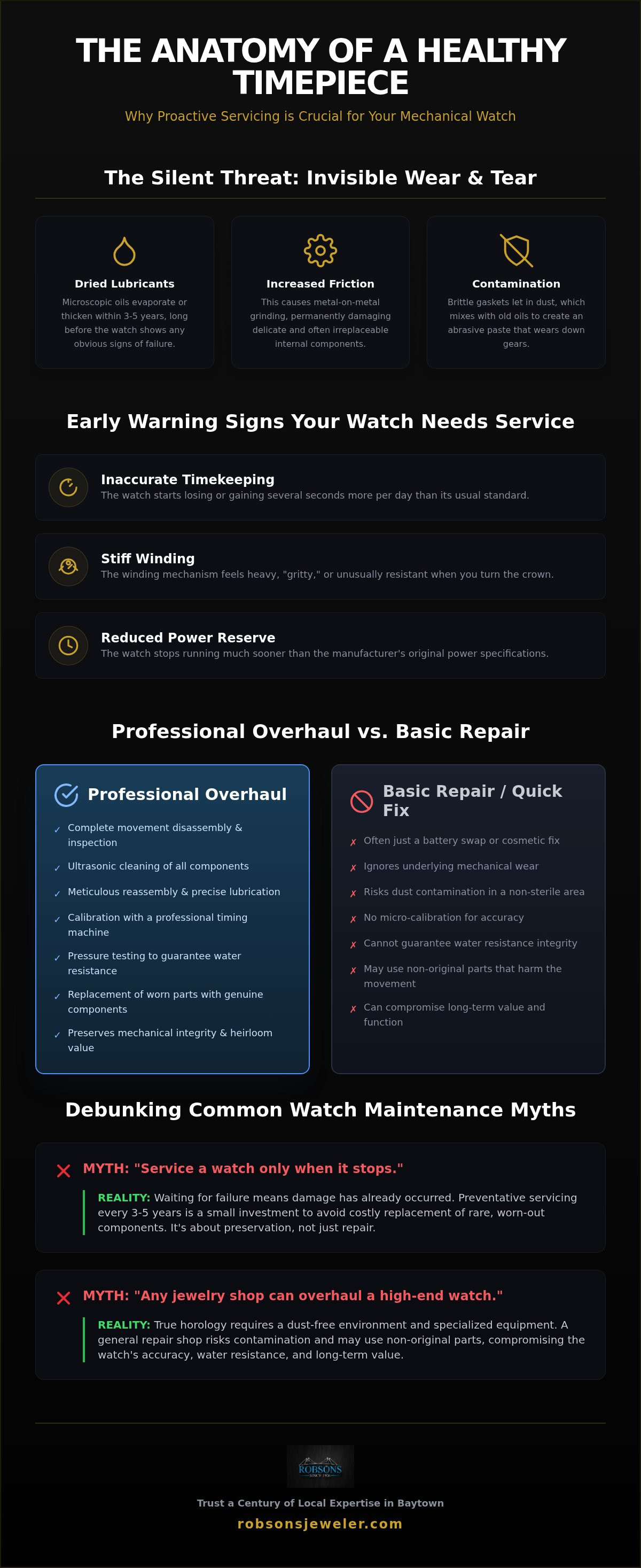
Horological friction is the primary silent killer of fine watches, occurring when degraded lubricants allow metal components to grind against one another until they lose their precise shape.
Myth #1: I should only service my watch when it stops running
This is the most common pitfall for watch enthusiasts. It's a mistake to wait for a total mechanical failure before seeking expert help. Microscopic synthetic oils are engineered to keep your watch running smoothly, but they typically evaporate or thicken after three to five years. When this happens, the watch doesn't stop immediately. Instead, it continues to run while the internal parts suffer from metal-on-metal wear. You might notice the watch keeps perfect time even as its internal gears are being slowly compromised. Consider these warning signs that often go unnoticed:
The watch starts losing or gaining several seconds more than usual each day.
The winding mechanism feels stiff, heavy, or "gritty" when you turn the crown.
The power reserve lasts significantly less time than the manufacturer's original specs.
By the time the hands finally seize, you aren't just looking at a service; you're looking at a costly replacement of rare components. Learning What is a Watchmaker? reveals that true horologists are trained to spot these invisible signs of wear before they become catastrophic.
The Reality of Mechanical Fatigue
The components of your watch, specifically the mainspring and the escapement, are under constant tension and high-frequency vibration. This creates a state of mechanical fatigue that can eventually lead to part failure. Beyond the gears, the external environment is a constant threat. Seals and gaskets that provide water resistance aren't permanent. Over time, they become brittle, allowing moisture and microscopic dust to enter the case. This debris mixes with old lubricants to create an abrasive paste that acts like sandpaper on the gears. Utilizing regular watch repair services in Baytown is the best way to ensure these barriers remain airtight. It's a small step that guarantees your timepiece remains a reliable companion for decades, rather than a relic that sits broken in a drawer.
Inside the Movement: Debunking the Myth That All Watch Repairs Are Equal
A professional watch servicing requires more than just a steady hand; it demands a workshop equipped with specialized tools that most general jewelry stores simply don't possess. While many shops offer "repairs," there's a vast technical chasm between a simple battery swap and a true horological overhaul. A trained horologist is a specialist who views your timepiece as a complex engineering marvel rather than just an accessory. To maintain the value and performance of high-end pieces, a workshop must utilize ultrasonic cleaners for deep-part sanitation, timing machines for micro-calibration, and pressure testers to ensure water resistance. Using non-original components introduces tiny variances in weight and friction that can throw off the delicate harmonic balance of the escapement, ultimately compromising the watch's long-term accuracy.
Myth #2: Any jewelry shop can handle a high-end watch overhaul
Entrusting a luxury timepiece to a general "back-room" repair shop often leads to unintended consequences. High-end movements require a strictly controlled, dust-free environment. Even a single microscopic speck of skin or lint can act like a boulder in a watch's gears, causing premature wear. Professional workshops also utilize specific Moebius oils, which are synthetic lubricants engineered for the distinct high-friction points within a movement. Without these, or if a technician uses a generic oil, the movement's longevity is cut short. Non-professional tools often leave lasting scars, such as scratched bridges or marred screw heads, which any collector or appraiser will spot instantly.
What a Professional Servicing Actually Entails
True professional watch servicing is a methodical, unhurried journey that restores a timepiece to its factory glory. It begins with a complete disassembly, where every gear, jewel, and spring is inspected for microscopic wear. The parts then undergo a multi-stage cleaning process in ultrasonic baths to remove every trace of old, acidic oil. Once clean, the horologist reassembles the movement, applying fresh lubricants with surgical precision. This level of detail is similar to the standards described by Sotheby's Watch Services, where every step is documented and verified for authenticity. Finally, the watch enters a 48-to-72-hour testing phase. We monitor the power reserve and accuracy in multiple positions to ensure it meets original factory specifications. At Robson’s Jewelers, we combine this technical rigor with a neighborly touch, treating your legacy with the same care we would our own. If you have questions about your timepiece, you can always visit us for expert watch repair advice in our showroom.
Professional Servicing vs. Quick Fixes: Why Your Timepiece Needs More Than a Battery
Many owners treat a quartz watch like a simple television remote, assuming that a fresh battery is the only care it will ever require. This is a risky misconception. While a battery provides the spark, the movement still relies on a physical train of gears to move the hands. Over time, the lubricants on these tiny wheels dry out, causing the motor to work harder and drain batteries faster. A professional watch servicing goes beyond a simple component swap. It ensures the internal environment of your timepiece remains pristine, protecting the delicate electronic circuit and mechanical parts from the silent threats of age and neglect.
Myth #3: A battery change is the only maintenance a quartz watch needs
Quartz movements are engineering marvels, but they aren't immortal. Even without a mainspring, they contain microscopic gears that require precise lubrication to prevent friction. When you visit a mall kiosk for a five-minute fix, you're often inviting trouble. These high-traffic environments are rarely dust-free. Opening a watch case in a public space can introduce skin cells, lint, or pollen directly into the movement. Furthermore, kiosks rarely replace the waterproof gaskets. These rubber seals degrade over three to five years; if they aren't replaced and lubricated during a battery change, your "waterproof" watch is suddenly vulnerable to the humid Texas air. If you've ignored your watch for too long, an old battery can leak caustic acid, which can bridge the circuit and destroy the movement entirely. This is why we recommend a comprehensive watch battery replacement in Baytown where the seals are checked as a standard part of the process.
The Comparison: Kiosk Quick-Fix vs. Professional Maintenance
The difference between a quick fix and professional care often comes down to the equipment used behind the counter. A professional horologist uses anti-magnetic tools and specialized brass tweezers that won't scratch or magnetize the movement. In contrast, generic tools can leave burrs on the metal or accidentally discharge the new battery before it's even installed. The Horological Society of New York advocates for high standards in education and technique, principles that we've mirrored in our Baytown showroom since 1926. After we install a battery, we don't just check if it ticks. We perform a vacuum and pressure test to ensure the case meets its original factory depth rating. This level of accountability is what separates a temporary fix from a legacy preserved. Trusting a century-old institution means you aren't just getting a battery; you're getting the peace of mind that your watch is sealed, lubricated, and ready for another few years of reliable service.
Preserving Your Legacy: Myths About Vintage Watch Maintenance and Value
A vintage watch is rarely just a tool for tracking hours. It's an artifact of a life well-lived, often carrying the emotional weight of family jewelry or religious and spiritual jewelry passed down through generations. When you hold an heirloom that once belonged to a grandfather or a mentor, the fear of damaging it is real. This hesitation often leads owners to keep the watch tucked away in a drawer, thinking they're "saving" it. However, a stagnant movement is a dying movement. Professional watch servicing is the only way to ensure these mechanical stories continue to tick for your children and grandchildren. Without it, the lubricants that once protected the delicate escapement turn into a hardened paste, creating a dangerous environment for the aging metal.
A seized movement in a vintage watch can lead to the breakage of "unobtainable" parts, turning a repairable heirloom into a permanent display piece. When a gear tooth snaps on a caliber that hasn't been manufactured in fifty years, the restoration becomes significantly more complex and invasive.
Myth #4: Servicing a vintage watch will decrease its collector value
There's a widespread fear in the collector community that any intervention ruins a watch's "originality." We need to draw a firm line between the movement and the aesthetic. Internal mechanical cleaning never devalues a watch; in fact, it preserves the very thing that makes it a watch. The "patina" on a dial or the original fade of a bezel is where the history lives. At Robson's Jewelers, we follow a strict "Do Not Polish" rule if that's your preference. You should always tell your jeweler exactly what you want to keep. While we ensure the engine is running with surgical precision, we can leave the case's character marks exactly as they are. Documented service history actually increases resale and appraisal value because it proves the piece has been cared for by a professional.
The Role of Certified Appraisals in Watch Care
Once your timepiece has undergone a major professional watch servicing, it's the perfect time to update your records. A watch that has been fully restored to working order is often worth more than a "for parts" non-running version of the same model. We provide Certified Appraisals to help you document the condition and value of your precious timepieces for insurance purposes. This ensures your family jewelry is protected against loss or damage with an accurate, modern valuation. Our team treats every consultation like a conversation between neighbors, helping you navigate the balance between mechanical function and historical preservation. If you're ready to breathe new life into a family heirloom, we invite you to schedule a consultation with Robson's Jewelers to discuss your watch's needs.
Trusting Your Timepiece to Robson’s Jewelers: A Baytown Tradition
Choosing a partner for professional watch servicing is a decision that balances technical requirement with deep personal trust. Since our founding in 1926, Robson's Jewelers has stood as a guardian of Baytown's most precious memories, serving as a century-old bridge between traditional craftsmanship and modern precision. We don't just fix watches. We preserve history. Whether you own a cutting-edge modern diver or a piece of religious jewelry that has been in your family for generations, our team treats your timepiece with the meticulous care it deserves. We invite our neighbors from Mont Belvieu, Seabrook, and Laport to visit our showroom on Henger St. to experience a higher standard of horological care.
The Robson's Difference: Meticulous Care Since 1926
Our approach is rooted in the "Trusted Family Mentor" philosophy, where every client is treated as a valued guest rather than a transaction. We believe in an unhurried pace. When you bring your watch to us, we take the time for a personalized one-on-one consultation to understand the history of the piece and your specific concerns. This allows us to tailor our professional watch servicing to your needs, ensuring that we respect the original character of vintage pieces while utilizing the latest digital calibration tools for modern movements. We view every repair as a preservation of Baytown’s local history, ensuring that the stories told by your timepieces never fade. This blend of old-world integrity and forward-thinking innovation is why families have trusted us for exactly one hundred years.
Your Next Steps for Watch Protection
Preparing for a service visit is simple, but a little preparation goes a long way in protecting your investment. If you have the original warranty booklets or previous service records, bring them along to help us build a comprehensive mechanical history for your watch. Before you arrive, take a moment to note any specific issues you've observed, such as the watch running fast or the crown feeling slightly loose. When you drop off your timepiece, don't hesitate to ask your horologist about the specific testing phases your watch will undergo. You should feel confident in the process, from the initial disassembly to the final pressure test. We're here to answer every question with honesty and expertise. Visit us at Robson’s Jewelers today for a professional assessment, and let us help you ensure your most precious timepieces last for the next hundred years.
Protecting Your Timepiece for the Next Century
Your watch is more than a machine; it's a heartbeat on your wrist that carries your most cherished stories. We've explored how waiting for a watch to stop is often a costly mistake and why the precision of a trained horologist far outweighs the convenience of a quick fix. Whether you're maintaining a modern masterpiece or a vintage heirloom, professional watch servicing remains the only way to ensure those gears continue to turn without silent damage. At Robson's Jewelers, we've been dedicated to this meticulous craft since 1926, serving Baytown families with professional integrity and expert care. We invite you to bring your legacy into our showroom for a personalized, neighborly consultation. Let's work together to keep your history ticking perfectly. Schedule Your Professional Watch Assessment at Robson's Jewelers today and give your most precious timepiece the expert attention it needs to last for generations to come.
Frequently Asked Questions
How often should I realistically have my watch professionally serviced?
Most manufacturers recommend a service interval of five to ten years to maintain peak performance. For example, modern Rolex models typically suggest a ten-year cycle, while Omega recommends five to eight years. This regular attention prevents microscopic oils from drying out and causing internal wear. Our experts in Baytown can assess your specific model to determine the ideal schedule for your lifestyle and usage.
Can I wind my automatic watch manually if I haven't worn it in a while?
You can safely wind most automatic watches manually by turning the crown. If your watch has been sitting idle, 30 to 40 turns will usually provide enough tension to reach a full power reserve. Avoid shaking the watch to start it, as this can put unnecessary stress on the oscillating weight. Winding by hand is a gentle way to wake up the movement before you set the time and wear it.
Is it safe to wear my 'water-resistant' watch in the shower or hot tub?
We advise against wearing even highly water-resistant watches in showers or hot tubs. The rapid temperature changes can cause metal components and rubber gaskets to expand and contract at different rates, potentially breaking the seal. Additionally, the chemicals in soaps and shampoos can dry out the gaskets over time. It's always safer to leave your timepiece in a dry place to avoid internal condensation or moisture damage.
What is the difference between a 'partial' and 'complete' watch service?
A partial service typically focuses on a specific external component, such as a crystal replacement or a new strap. In contrast, professional watch servicing is a complete mechanical overhaul. This comprehensive process includes disassembling the movement, cleaning every part in ultrasonic baths, applying fresh synthetic lubricants, and replacing all waterproof seals. It's the difference between a cosmetic touch-up and ensuring the long-term health of the internal engine.
Why does professional watch servicing take several weeks to complete?
Meticulous horology requires time for both precision work and rigorous testing. After the movement is cleaned and reassembled, it must undergo a multi-day observation period. We test the watch in various positions and monitor the power reserve for 48 to 72 hours to ensure it keeps time accurately. This unhurried pace is how we've maintained our reputation for reliability in the Baytown area for exactly one hundred years.
Will professional servicing remove the scratches on my watch's crystal or case?
A standard service usually includes a thorough cleaning of the case and bracelet to remove dirt and oils. While light surface marks often disappear during this process, deeper scratches might require specialized polishing. We always discuss this with you first, especially for vintage pieces where over-polishing can reduce the watch's value. Our goal is to balance a refreshed appearance with the preservation of the watch's original character and sharp edges.
How can I tell if my watch has been magnetized, and does it need a full service?
If your timepiece suddenly begins gaining several minutes a day, it has likely been magnetized by a nearby electronic device. This is a common issue in 2026 given our proximity to smartphones and magnetic tablets. Fortunately, magnetization doesn't usually require a full mechanical service. We can typically resolve the problem in our showroom using a demagnetizer, which restores the balance spring's proper rhythm in just a few moments.
Does Robson's Jewelers offer warranties on their watch repair services?
Robson's Jewelers provides a limited warranty on all professional watch servicing overhauls to give you peace of mind. As a family-owned business serving the Baytown and Mont Belvieu communities since 1926, our integrity is our most valuable asset. We treat every repair as a preservation of your family's legacy. If you experience any issues with our work, we're here to make it right with the same neighborly care we've offered for a century.


Comments