


HPHT Diamonds La Porte: Quality, Value and How They’re Made

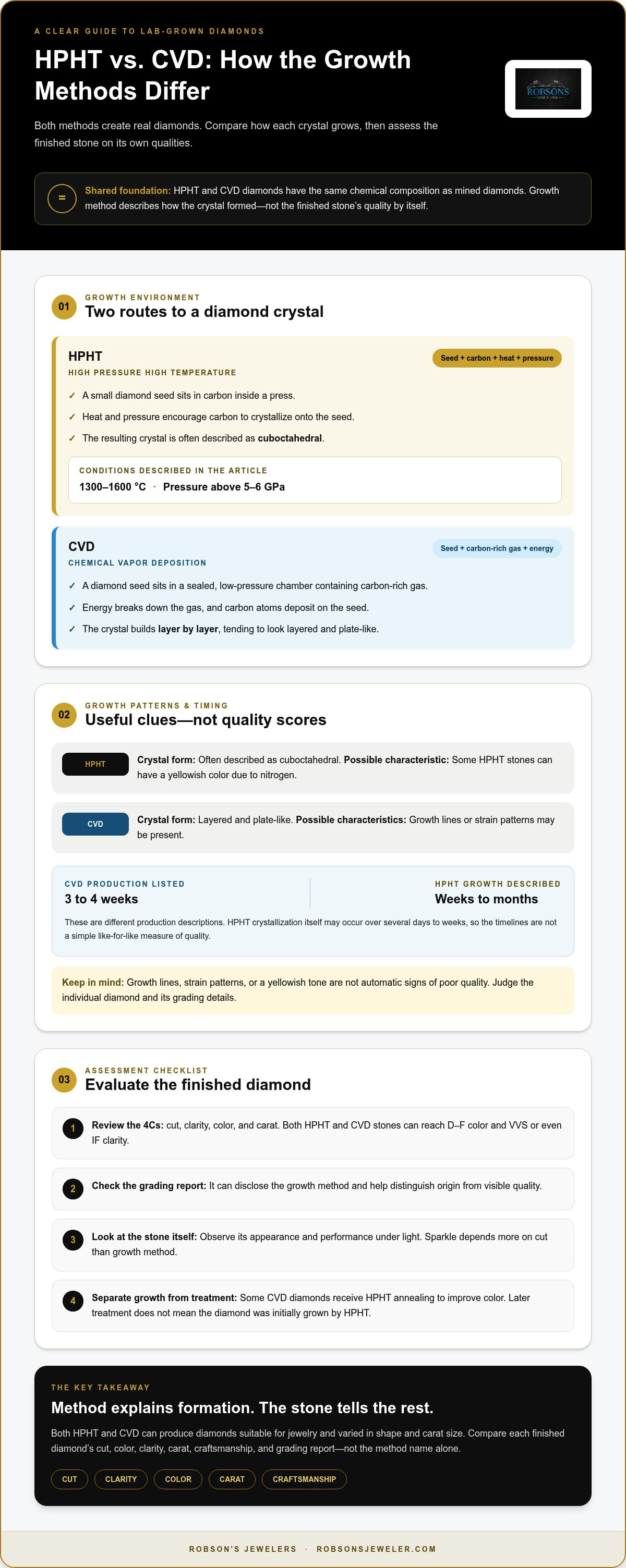
A lab-grown diamond isn’t an imitation: HPHT diamonds in La Porte are real diamonds, created by growing carbon onto a diamond seed under intense pressure and heat. The HPHT method recreates conditions that encourage diamond crystals to form, while CVD grows diamonds layer by layer inside a chamber. Both methods produce diamonds with the same chemical composition as mined diamonds.
It’s natural to wonder whether a newer growth method changes a diamond’s beauty, durability, or worth. The method doesn’t change what the diamond is, but its growth process, finished quality, and production choices are useful points of comparison.
Here, you’ll learn how HPHT growth works, how it differs from CVD, and what the methods mean for quality, environmental impact, and cost compared with mined diamonds. We’ll also explain what to look for when assessing a lab-grown diamond, so you can weigh the details with confidence as you consider a piece for a meaningful milestone.
Table of Contents
Lab-Created Diamond Quality: As Good As Natural?
HPHT means High Pressure High Temperature, a method that grows diamond crystals from carbon under intense heat and pressure. Lab-grown diamonds share the chemical composition and crystal structure of natural diamonds, so growth origin alone doesn’t determine beauty or durability.
Lab-Grown and Natural Diamond Differences
Lab-grown diamonds form in controlled equipment, while natural diamonds develop underground over billions of years. Both are diamond material, with the same crystal structure, hardness, and many optical properties. Their origin may matter if you value geological formation, but it doesn’t make one a different gemstone.
In HPHT growth, a small diamond seed sits in carbon inside a press. Heat and pressure encourage carbon to crystallize onto the seed, forming a larger crystal. The crystal may be extracted after 5-20 days. This process recreates conditions that help diamonds form, rather than copying a natural diamond’s journey underground.
For appearance and wear, compare the finished stone rather than relying on its origin. HPHT and CVD diamonds both score 10 on the Mohs hardness scale. Lab-grown diamonds are virtually indistinguishable from natural diamonds to the naked eye, and both can show strong optical performance. A diamond’s sparkle depends more on its cut than its growth method.
Use the 4Cs, cut, clarity, color, and carat, to compare individual stones. Both lab-grown and natural diamonds receive these grades, and HPHT and CVD stones can reach D-F color and VVS or even IF clarity. A grading report can disclose the growth method, helping you distinguish origin from visible quality when comparing a colorless stone or choosing an engagement ring.
Lab-Grown and Mined Diamond Costs
Lab-grown diamonds are generally less expensive than mined diamonds, though the difference depends on the stone and its quality. That relative value can let a buyer compare options with similar carat, cut, color, and clarity. It doesn’t mean every lab-grown stone offers the same value: craftsmanship and the finished diamond’s 4Cs still matter.
For a practical comparison, match stones by carat and grading details, then consider how each fits your priorities. A mined diamond reflects a natural formation process lasting billions of years; a lab-grown diamond offers the same diamond material with a different origin. The growth method explains how the crystal formed, while cut, clarity, color, and craftsmanship shape its appearance and value.
Differences between the growth methods
HPHT and CVD create real diamonds through different crystal-growth environments. Their processes affect how a crystal forms, but neither method alone determines its finished appearance or quality.
HPHT stands for High Pressure High Temperature. In this method, a diamond seed and carbon source experience intense pressure and heat, encouraging carbon to crystallize onto the seed. The resulting crystal is often described as cuboctahedral. HPHT was among the earliest technologies used to create lab-grown diamonds, with the first HPHT diamonds made in the 1950s.
CVD means chemical vapor deposition. A diamond seed sits inside a sealed, low-pressure chamber containing carbon-rich gas. Energy breaks down the gas, and carbon atoms deposit on the seed’s surface, building the crystal layer by layer. This formation tends to look layered and plate-like, unlike the characteristic crystal structure associated with HPHT growth.
Growth timelines differ, but they aren’t a simple measure of quality. CVD diamond production is listed at 3 to 4 weeks. HPHT growth can take weeks to months, while crystallization itself may occur over several days to weeks. These descriptions refer to different parts of production, so a single timeline doesn’t explain every diamond’s growth cycle.
Each method can produce diamonds in varied shapes and carat sizes. CVD stones may show growth lines or strain patterns associated with their layered formation. HPHT stones can sometimes have a yellowish color due to nitrogen. These characteristics aren’t automatic signs of poor quality; the individual stone’s grading and appearance matter.
Post-growth treatment can also blur the distinction between methods. Some CVD diamonds receive HPHT annealing to improve color. That later treatment doesn’t mean the diamond was initially grown using HPHT. Growth method and treatment describe separate stages, so a grading report that discloses the growth method helps clarify a stone’s history.
For a useful comparison, consider the grading report alongside the finished diamond. Review its cut, color, clarity, and carat, then observe how the stone performs under light. Growth patterns explain how the crystal formed; they don’t replace evaluation of the finished material. Both HPHT and CVD can produce diamonds suitable for jewelry, so let the specific stone’s qualities guide your choice.
If you’re weighing the methods for a personal piece, comparing loose lab-grown diamonds alongside their grading details can make the differences easier to understand. Focus on the qualities you value in the finished diamond, not just the name of its growth process.
Heat and pressure conditions
HPHT growth uses controlled equipment to recreate conditions that let carbon form diamond crystals. The cell combines a diamond seed, a carbon source, extreme pressure, and high heat.
In the described process, the HPHT cell reaches 1300-1600 °C. Pressure rises above 5-6 GPa, creating an environment where carbon can crystallize onto the seed. These conditions support crystal growth; they don’t simply heat an existing diamond into a larger stone.
The seed provides the starting structure. Carbon atoms move through the growth environment and attach to the seed, building a diamond crystal. The crystal develops through the combined effects of heat, pressure, and the carbon source, rather than any single condition working alone.
Pressure is essential because it helps carbon atoms arrange into diamond’s crystal structure. Heat enables carbon to move through the growth cell and reach the seed. Carefully controlling both conditions supports crystal formation, while changes in the growth environment can affect the resulting crystal’s characteristics.
Natural diamond formation also involves intense conditions, though it occurs underground. Natural diamonds form deep underground under intense heat and pressure. Pressure can reach 725,000 pounds per square inch, while the HPHT process applies pressure above 870,000 pounds per square inch. The comparison shows why HPHT is named for its defining conditions, not that its entire process is identical to geology.
Natural formation takes billions of years, while HPHT growth takes place in a controlled cell. The equipment creates a focused environment around a seed and carbon source. A natural diamond develops through geological processes; an HPHT diamond grows through a managed process designed to produce diamond material.
These production conditions explain the method, but don’t determine every visible quality. Pressure and heat help create the crystal; the finished diamond’s cut, color, and clarity describe other qualities. Hardness comes from diamond’s crystal structure, not from whether the original pressure came from geological forces or an HPHT press.
For readers comparing HPHT with CVD, the key distinction is the growth environment. HPHT uses pressure and heat around carbon and a seed. CVD deposits carbon atoms onto a seed inside a low-pressure chamber. Both methods create diamond crystals, but their conditions and growth patterns differ.
How can I tell whether a diamond was grown using HPHT?
Start with the diamond’s grading report. Lab-grown diamond reports disclose the growth method, making the report more useful than appearance alone. HPHT and CVD stones can look alike to the naked eye, and both can have excellent cut, color, and clarity. The method describes how the crystal formed, not a visible label on its surface.
Read the grading report
Look for the report’s identification of the diamond as lab-grown and its stated growth method. GIA, IGI, and GCAL are organizations named for lab-grown diamond certification. Match the report to the stone by checking its identifying details, then review the 4Cs: cut, clarity, color, and carat. This separates method identification from the qualities that shape appearance and value.
Know what physical clues can and can’t show
HPHT diamonds may contain metallic inclusions from catalysts used during growth. These inclusions are internal features, not a reliable visual label for every HPHT stone. Their presence can be a clue, but one feature alone can’t identify a diamond’s origin. CVD diamonds can show growth lines or strain patterns, while HPHT crystals develop in a different growth environment.
Standard handheld diamond testers can also produce different results with some HPHT diamonds. That variation reflects characteristics developed during growth; it doesn’t establish the method by itself. Consider a tester reading alongside the grading report, rather than treating it as a substitute for gemological identification. A result from one instrument alone can’t explain the diamond’s full origin or grading.
Use a simple comparison process
Match the report: Compare its identifying details with the diamond being examined.
Find the method: Read the report’s lab-grown disclosure for HPHT or CVD identification.
Review the grading: Compare cut, clarity, color, and carat separately from growth method.
Interpret clues carefully: Treat metallic inclusions or tester results as context, not stand-alone proof.
For example, a report identifying HPHT growth is more useful than guessing from a yellowish tint or handheld tester result. Nitrogen can sometimes contribute to yellowish color in HPHT diamonds, but color alone doesn’t prove the method. The report provides the clearest documented distinction, while visual assessment helps you understand the individual stone’s appearance.
In short, use documentation first, then consider physical characteristics as supporting details. The same approach helps compare lab-grown and mined diamonds without confusing origin with quality. A grading report tells you the stated growth method; the 4Cs help you assess the finished diamond.
Are HPHT diamonds treated after growth, and how should they be cared for?
Yes, HPHT can also describe a treatment applied after a diamond’s initial growth. Some lab-grown diamonds receive HPHT treatment to improve color. That’s separate from growing a diamond using HPHT: one describes a later treatment, the other describes how the crystal formed. Knowing the distinction helps you understand what a grading report says about a diamond’s origin and processing.
CVD diamonds are often treated with HPHT annealing to improve color. Annealing changes a diamond through controlled heating and cooling. The Gemological Institute of America describes annealing as a process often used after irradiation to further adjust color. In other words, a CVD-grown diamond can receive HPHT treatment without having been HPHT-grown. Growth method and post-growth treatment are different details.
Care for an HPHT diamond as you would other diamond jewelry. For routine cleaning, gently scrub the stone with a soft brush, mild dish soap, and warm water. A soft brush helps reach around the setting, where everyday residue can collect. Handle the piece carefully over a secure surface, and avoid rough scrubbing that could affect the setting.
Cleaning and professional inspection
Avoid harsh jewelry cleaners, ultrasonic cleaners, and steam cleaners for HPHT diamonds. These methods can be unsuitable for the jewelry setting or any treatments and materials around the stone. A jeweler’s inspection and cleaning every 6 months, if possible, can help assess the piece as a whole. The setting matters too: a diamond may be durable, but its mounting still needs care.
Daily habits can also protect diamond jewelry. Remove it before exercise, cooking, swimming, or other active tasks. For example, taking off a ring before cooking helps avoid food residue and accidental knocks. Put it somewhere secure, then clean it later with mild soap and warm water. Keeping the routine simple makes regular care easier to remember.
Clean gently: Use a soft brush, mild dish soap, and warm water.
Avoid harsh methods: Skip harsh cleaners, ultrasonic cleaning, and steam cleaning.
Remove jewelry for active tasks: Take it off before exercise, cooking, swimming, or similar activities.
Schedule upkeep: Have a jeweler inspect and clean the jewelry every 6 months, if possible.
When comparing a diamond’s records, separate its growth method from any later color treatment. Then give the finished jewelry steady care, including gentle cleaning and periodic inspection. Explore loose lab-grown diamonds as you compare diamond options and their documented details.
Robson's Jewelers: Engagement Rings
Robson's Jewelers offers engagement rings, loose lab-grown diamonds, and custom jewelry design for those ready to turn their diamond research into a meaningful piece. If you’re comparing HPHT and CVD stones, explore individual loose diamonds and consider the qualities that matter to you. Custom design can shape a ring around your preferences, while jewelry repair helps care for a piece you already own. Whether you’re beginning to explore engagement rings or have a clearer idea of the diamond you want, visit Robson's Jewelers in Baytown or explore robsonsjeweler.com to take the next step.
Choose a Diamond That Feels Like Yours
If you’re considering HPHT diamonds in La Porte, let your priorities guide the next step: the look you love, the story you want your jewelry to carry, and how you plan to wear it. A meaningful ring isn’t defined by its growth method alone. Its design should feel personal, comfortable, and true to the person who will wear it.
Robson's Jewelers offers engagement rings and custom jewelry design for those creating a new piece, along with jewelry repair for a treasured ring. Whether you’re starting with a loose diamond or refining a design idea, thoughtful choices can bring the details together in a way that feels distinctly yours.
Contact Robson's Jewelers to discuss diamonds and take the next step toward a piece you’ll be glad to wear and cherish.
Frequently Asked Questions
What is High Pressure High Temperature (HPHT)?
High Pressure High Temperature, or HPHT, is a method for creating lab-grown diamonds by applying intense pressure and heat to carbon around a diamond seed. It’s one of two common diamond-growth methods, alongside chemical vapor deposition (CVD). The name identifies the environment used to grow the crystal, not a separate kind of gemstone. For a buyer, the distinction helps explain a diamond’s origin and what its grading report records.
What is the HPHT Process to Grow Lab Diamonds?
The HPHT process begins with a diamond seed and a carbon source placed inside specialized growth equipment. The equipment supplies heat and pressure, allowing carbon to form a larger diamond crystal around the seed. After growth, the rough crystal is prepared for cutting and polishing. Those later steps shape the finished stone, so the uncut crystal’s appearance isn’t the same as a finished diamond’s.
How Does HPHT Work?
HPHT works by creating an environment that encourages carbon to form a diamond crystal around a seed. The seed serves as the starting point for the new material, while the equipment maintains the growth conditions. Once the crystal is grown, cutters shape it to bring out its finished appearance. For someone comparing diamonds, the growth method explains formation, while the cut describes a later stage of the stone’s development.
Should You Choose an HPHT Diamond Over a Natural Diamond?
Choose based on the qualities and origin you value, rather than assuming one option is best for everyone. For example, you may prefer a lab-grown diamond’s origin or place importance on a diamond formed through geological processes. Compare the individual stones’ grading details and appearance, then consider which story fits the piece you’re choosing. For an engagement ring, deciding what matters most to you and your partner can make comparisons more meaningful.
What Are Lab Grown Diamonds?
Lab-grown diamonds are created in controlled settings rather than formed naturally underground. They’re made of diamond material and can be fashioned into jewelry just like mined stones. HPHT and CVD are growth methods, not different names for the finished jewelry. For example, a lab-grown diamond may be set in an engagement ring or selected as a loose stone, with its grading details helping describe its individual qualities.
What are HPHT diamonds?
HPHT diamonds are lab-grown diamonds formed using the High Pressure High Temperature method. The term describes how the diamond was grown, not its shape, setting, or intended use. A finished HPHT stone can be evaluated by its grading details and considered for a ring or another jewelry design. Any later treatment is a separate detail from its original growth method.
Which jewelry stores near La Porte sell HPHT diamonds?
Robson's Jewelers offers loose lab-grown diamonds and engagement rings for shoppers comparing diamond options. If you’re looking for HPHT diamonds in La Porte, explore the store’s lab-grown diamonds and consider how a stone suits a ring or custom design. Robson's Jewelers serves Baytown, Mont Belvieu, Seabrook, La Porte, Dayton, and the greater East Houston area. Its custom jewelry design service can help shape a piece around a chosen diamond.
What is the price of HPHT diamonds in La Porte?
There isn’t one price for every HPHT diamond in La Porte; the individual stone’s qualities shape its value. Carat, cut, color, clarity, and grading documentation are useful details to compare. The setting and overall jewelry design also affect the finished piece. For a fair comparison, consider diamonds with similar grading characteristics, then decide whether you’re choosing a loose stone or an engagement ring.
Comments