


Jewelry Maintenance and Cleaning: The Ultimate Guide to Lasting Sparkle

Imagine glancing down at your hand and realizing your engagement ring looks more like a piece of frosted glass than a brilliant diamond. It happens slowly; lotions, soaps, and daily life build up a film that hides the fire of your stones and dulls the glow of your gold. At Robson's Jewelers, we've seen this story unfold for generations since 1926. Your jewelry carries your most precious memories, so it's natural to feel a bit of anxiety about jewelry maintenance and cleaning. You don't want to use the wrong chemical and cause permanent damage.
We understand that hesitation. We're here to help you restore that original luster safely at home and help you identify the subtle signs of wear before a stone falls out. This guide provides a clear path to preserving your collection for the next generation. We'll explore the best weekly cleaning routines, the specific needs of different metals, and the crucial moments when you should trust a professional to handle your heirlooms.
Table of Contents
Why Jewelry Maintenance and Cleaning is Essential for Longevity
Most people think a quick dip in a solution is all their rings need to stay beautiful. Real jewelry maintenance and cleaning goes much deeper than surface sparkle. It's a dual approach that combines aesthetic restoration with structural preservation. When you wear your favorite gold band every day, it collects microscopic particles of dust and grit. These tiny fragments act as a silent abrasive. Over time, they literally grind away at the metal of your prongs and shanks, thinning the very foundation that holds your stones in place.
For our neighbors in Mont Belvieu and Dayton, these pieces aren't just accessories. They're the physical threads of a family's history. Since 1926, we've seen how a lack of consistent care can turn a cherished heirloom into a lost stone. Preserving these memories for the next generation requires more than just an occasional wipe down. It requires a commitment to protecting the integrity of the piece against the wear and tear of daily life.
The "Baytown Factor" also plays a significant role in how your jewelry ages. Living near the coast adds a layer of complexity that many inland guides overlook. The salt air and high humidity in our region accelerate tarnish on silver and can even affect certain lower-karat gold alloys. Understanding your local environment is the first step in a successful long-term care plan.
The Difference Between Cleaning and Maintenance
Cleaning is the process of removing the film left by lotions, soaps, and oils to restore a diamond's fire. Maintenance is the technical check of a piece's health. You can have a ring that looks brand new but has a paper-thin prong ready to snap. While various Jewellery cleaning methods can remove surface grime, only a skilled hand can ensure your stone stays securely in its seat. A "clean" ring can still be a "dangerous" ring if the structural integrity has been compromised by years of friction.
Environmental Hazards in the Texas Gulf Coast
The Texas Gulf Coast is beautiful, but it's tough on fine jewelry. High humidity keeps moisture trapped against the metal, while salt air promotes oxidation in sterling silver. Chlorine is another major culprit often found in backyard pools. It's a harsh chemical that can actually leach the alloys out of gold, making it brittle and prone to cracking over time. Sweat and sunscreen create a sticky, acidic residue that traps abrasive grit against your settings and dulls the brilliance of your gemstones.
Material-Specific Care: From Mined Diamonds to Modern Brilliance®
Understanding the Mohs scale of hardness is the foundation of smart jewelry ownership. This scale ranks minerals from 1 to 10 based on their ability to scratch one another. While a diamond sits at a perfect 10, a pearl rests between 2.5 and 4.5. This vast difference means your jewelry maintenance and cleaning approach must adapt to the specific vulnerability of each piece. Harder stones like those in our Modern Brilliance® Collection can handle more vigorous scrubbing than a porous opal or an organic pearl.
Many of our clients wear religious and spiritual jewelry 24/7. Because these pieces are rarely removed, they face constant exposure to sweat, soaps, and friction. This makes regular jewelry maintenance and cleaning even more critical to prevent buildup in the intricate details of a crucifix or a Star of David. If you're unsure about the hardness of your specific gemstone, we invite you to stop by for a quick consultation; we'd love to help you identify the best care plan for your most meaningful pieces.
Caring for Diamonds and Hard Gemstones
Diamonds are notorious grease magnets. They have a natural affinity for oils, meaning every time you touch your stone, you transfer skin oils that act like a dulling film. This film prevents light from entering and reflecting, which is why even the highest quality lab-grown diamonds can lose their fire if not cleaned regularly. To keep that brilliance, try to handle your rings by the metal band rather than the stone itself. Whether you're wearing mined diamonds or pieces from the Modern Brilliance® Collection, consistent care ensures the light refraction remains crisp and vibrant. You can find excellent tips on How to Clean Your Jewelry at Home to maintain that daily glow.
Special Handling for Pearls and Porous Stones
Pearls, opals, and turquoise require a much gentler touch. These are porous materials that can be permanently damaged by chemicals or dehydration. We always recommend the "last on, first off" rule: put your jewelry on after applying perfume and hairspray, and take it off before your evening skincare routine. Over time, the silk thread in a pearl necklace can stretch or weaken from absorbing these products. Professional pearl restringing is a vital maintenance step to prevent a sudden break. When storing these delicate stones, keep them in a soft pouch away from harder gems to prevent surface scratches.
The Professional Advantage: When to Visit Robson's Jewelers
While consistent home care keeps your pieces bright, it doesn't replace the "Semi-Annual Sparkle" rule. Every six months, your jewelry deserves a professional evaluation. This industry standard isn't just about aesthetics; it's about safety. Over 100 years of experience has taught us that a stone lost is a memory fractured. A professional jewelry maintenance and cleaning session at Robson’s goes far beyond what a toothbrush can achieve at your kitchen sink.
During a professional jewelry inspection in Baytown, we use specialized equipment to treat your treasures. Our ultrasonic cleaners use high-frequency sound waves to shake loose compacted dirt from deep within the gallery of a ring. We follow this with high-pressure steam to blast away residual oils. Sometimes, this deep clean reveals hidden issues, like a thinning setting that requires jewelry prong repair to keep your diamond secure. It's much better to find a loose stone during a cleaning than to find an empty setting while you're out running errands.
Beyond the Surface: The Structural Check-Up
Our experts use high-powered magnification to examine your pieces for hairline fractures. These tiny cracks often form in the metal due to daily stress or simple age. We also check for "stone spin," a common issue in engagement rings where the center stone becomes loose in its seat. Even the heavy, durable bracelets from our Bracelet Bar need their clasps verified for tension. We ensure every mechanism clicks shut with the confidence you expect from fine jewelry.
Restoring the Finish: Polishing and Rhodium Plating
If your white gold looks slightly yellowish or dull, it likely needs rhodium plating. This process involves electroplating a thin layer of rhodium over the gold to restore its brilliant, mirror-like finish. While a home wipe removes dust, our professional buff and polish removes the microscopic surface scratches that accumulate over time. We approach older pieces with a different level of caution. Excessive polishing can strip away the unique patina and delicate details that give antique jewelry its historic character. Our goal is always to enhance the beauty of your piece without erasing its history.
How to Clean Your Jewelry at Home: A Step-by-Step Guide
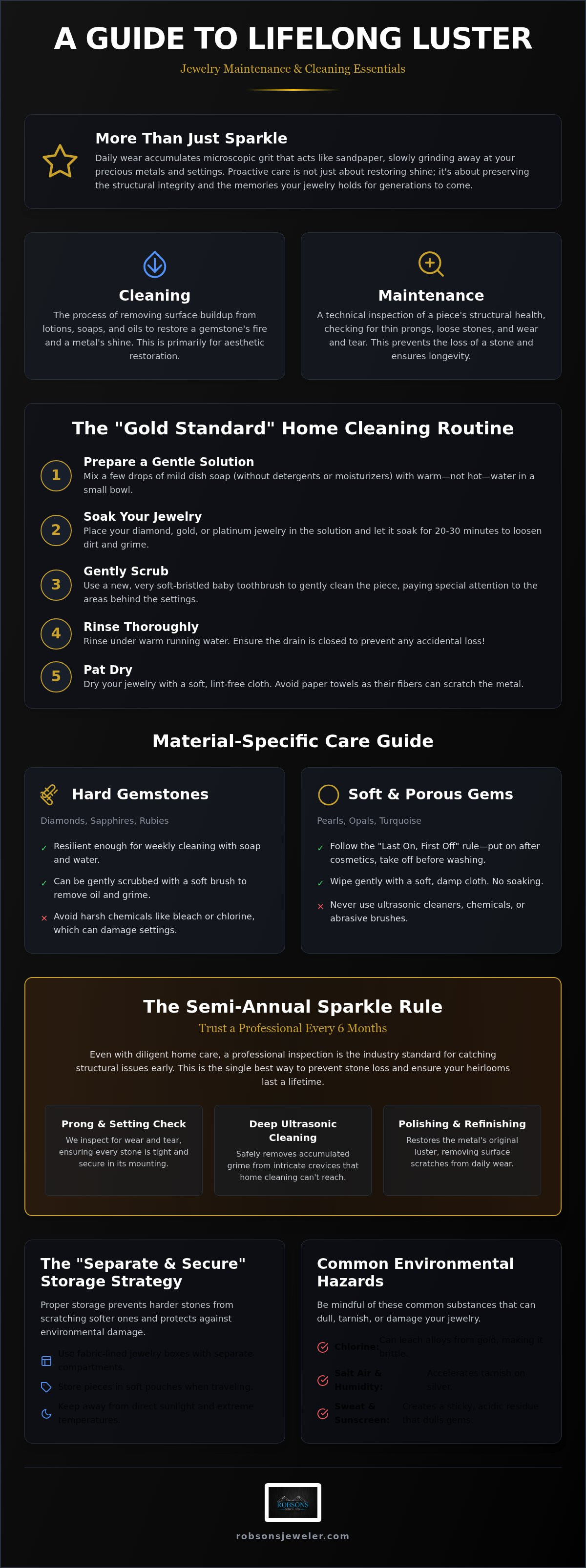
Maintaining the radiance of your collection doesn't require a specialized laboratory; it simply requires a bit of intentionality. Consistent jewelry maintenance and cleaning at home serves as the vital bridge between your professional semi-annual check-ups. We recommend the "Gold Standard" recipe: a small bowl of warm water mixed with a few drops of mild, additive-free dish soap. Avoid soaps that promise "extra-strength" degreasing or contain moisturizers, as these often leave a stubborn film that dulls the very sparkle you're trying to restore.
Before you begin the process, follow the most important safety rule in the jeweler's handbook: close the sink drain. It sounds simple, but many precious heirlooms have been lost to the plumbing during a routine rinse. Once your workspace is secure, you're ready to begin the gentle restoration of your favorite pieces.
The 15-Minute Weekly Refresh Routine
This routine is designed to be gentle enough for weekly use while remaining effective at removing the buildup of daily life. Follow these three steps to keep your jewelry looking its best:
Step 1: The Soak — Submerge your jewelry in the warm, soapy solution for about 15 minutes. This unhurried soak softens organic buildup like lotions, oils, and perfumes without the need for harsh chemicals.
Step 2: The Gentle Scrub — Use an extra-soft baby toothbrush to reach the intricate areas. Focus specifically on the "pavilion," which is the underside of the stone. This area acts as a trap for grime, and cleaning it is the secret to unlocking a diamond's true fire.
Step 3: The Rinse and Dry — Rinse each piece thoroughly in a separate bowl of clean, warm water to ensure no soap residue remains. Finally, dry your jewelry with a lint-free microfiber cloth. Avoid paper towels; they can leave tiny scratches on soft metals or snag on delicate prongs.
What to Avoid: Common Household Myths
In our century of service, we've seen the damage caused by well-intentioned but dangerous home cleaning "hacks." Toothpaste is a common culprit. While it's great for enamel, it contains abrasives that can permanently scratch gold and softer gemstones. Boiling water is another hazard; the sudden temperature change can cause thermal shock, leading to internal fractures in stones with inclusions, such as emeralds or opals. You should also steer clear of "miracle" chemicals like bleach or ammonia. These harsh substances can actually embrittle gold alloys over time, making your settings prone to cracking or stone loss.
If your jewelry still appears cloudy after a home refresh, it may need the deep-cleaning power of a professional laboratory. When you're ready for a thorough structural check and restoration, we invite you to consult with the experts at Robson's Jewelers to preserve your most cherished pieces.
Preserving Your Legacy: Storage and Long-Term Care
Preserving your jewelry is about more than just aesthetics; it's about safeguarding the physical reminders of your family's most significant milestones. While daily care and professional cleaning are vital, how you store your treasures when they aren't being worn determines their longevity. Effective jewelry maintenance and cleaning includes a thoughtful approach to storage that prevents unnecessary friction and environmental damage. Since 1926, we've helped families protect their legacies by teaching the "Separate and Secure" rule. Diamonds are the hardest natural substance on Earth. This means they can easily scratch your gold, platinum, and even other gemstones if left to rattle around together in a common jewelry box.
Smart Storage Solutions
Invest in fabric-lined boxes with individual compartments to avoid a "jewelry jumble." This organization isn't just for convenience; it's a protective measure. For our neighbors in the humid Texas Gulf Coast, the air itself can be a challenge to metal integrity. We recommend using anti-tarnish strips in your silver storage to combat the moisture-driven oxidation that's so common in our region. Don't store fine jewelry in plastic bags or damp areas like bathrooms. Plastic can trap moisture and chemicals that react with certain alloys, while humidity can weaken the structural integrity of organic gems like pearls.
Documenting Your Collection
A well-maintained collection is a well-documented one. We encourage you to keep a maintenance log that tracks every professional cleaning, prong check, and repair. This record does more than just organize your history. Regular professional inspections are often a mandatory requirement for maintaining coverage under jewelry insurance policies. If you cannot prove the piece was in good repair before a stone was lost, a claim may be difficult to process. This is where certified jewelry appraisals become essential. A professional valuation at Robson’s provides the legal and financial documentation needed to protect your investment and ensure your legacy is properly valued.
If you have inherited pieces that have seen better days, consider a professional heirloom jewelry restoration before placing them into long-term storage. Preparing these pieces correctly ensures that age-related wear doesn't worsen while they sit in a safe. We invite you to visit our Baytown showroom for a personalized care consultation. Let us be your trusted mentors in preserving your jewelry for the generations still to come.
Protecting Your Treasures for the Years Ahead
Your jewelry collection is a mosaic of your life's most beautiful moments. By balancing a gentle weekly home routine with semi-annual professional check-ups, you ensure those memories remain as vibrant as the day they were created. Proper jewelry maintenance and cleaning isn't just about looking good; it's a vital commitment to the structural safety of your heirlooms. Whether you're caring for a new engagement ring or a century-old family piece, the right storage and cleaning habits prevent the slow, abrasive wear of daily life.
We've served the Baytown community since 1926 with a deep dedication to craftsmanship and neighborhood trust. Our family-owned business brings GIA and IGI certified expertise to every piece we handle, ensuring your treasures are in the most capable hands. Don't wait for a stone to feel loose or a prong to snag before seeking expert eyes. Visit Robson's Jewelers in Baytown for a Professional Jewelry Inspection today. We're here to help you keep your legacy shining bright for the many generations still to come.
Frequently Asked Questions
How often should I have my engagement ring professionally cleaned?
You should have your engagement ring professionally inspected and cleaned every six months. This "Semi-Annual Sparkle" rule allows us to verify that your prongs are secure and your stones aren't at risk of falling out. While your weekly home routine keeps the diamond bright, a professional visit ensures the structural integrity of your setting remains intact. It's the most effective way to protect your investment and maintain that original showroom glow.
Can I use an ultrasonic cleaner at home for all my jewelry?
No, ultrasonic cleaners aren't safe for every piece in your collection. While they work wonders for hard stones like those in our Modern Brilliance® Collection, the intense vibrations can damage porous gems like opals, emeralds, and pearls. These machines can also shake stones loose from delicate pave or tension settings. We recommend saving the ultrasonic treatments for professional visits where an expert can monitor the process and ensure your jewelry’s safety.
Is it safe to clean my jewelry with Windex or vinegar?
You should avoid using harsh household cleaners like Windex or vinegar on your fine jewelry. Ammonia and acids can be far too abrasive, potentially etching the surface of softer gemstones or causing the alloys in your gold to become brittle over time. To ensure safe jewelry maintenance and cleaning, stick to the "Gold Standard" of warm water and mild, additive-free dish soap. This gentle approach restores luster without risking permanent chemical damage.
What should I do if I notice a loose stone in my ring?
If you notice a stone spinning or rattling, stop wearing the piece immediately and place it in a soft, sealed pouch. Do not attempt to tighten the prongs yourself with household tools; you could accidentally crack the gemstone or snap the metal. Bring the item to a trusted jeweler for a structural repair. Addressing these red flags early is the best way to prevent the heartbreak of a lost diamond or heirloom.
How do I clean my pearls without damaging the nacre?
Clean your pearls by gently wiping them with a soft, damp cloth after each wear. You can use a very diluted solution of mild soap if they appear particularly dull, but never submerge them in water. Soaking can weaken the silk thread, leading to a sudden break. Because pearls are organic and porous, they require specialized care. We also recommend professional pearl restringing every few years to keep the strand secure and beautiful.
Why does my white gold ring look yellowish, and can cleaning fix it?
A yellowish tint on white gold is a natural sign that the rhodium plating has worn away, and standard cleaning won't fix it. Most white gold is actually yellow gold mixed with white alloys and then plated with rhodium for a bright finish. Over time, friction and oils wear this layer down. To restore that crisp, mirror-like appearance, you'll need a professional jeweler to perform a rhodium replating, which we typically recommend once a year.
Should I take my jewelry off when I shower or swim?
Yes, removing your jewelry before showering or swimming is a vital habit for long-term preservation. Showering leads to a heavy buildup of soap scum and hard water deposits that are difficult to remove from intricate settings. In pools, chlorine can cause stress corrosion in gold alloys, making them brittle. By taking your pieces off, you avoid chemical exposure and keep your jewelry maintenance and cleaning routine much simpler and more effective over time.
What is the best way to clean my watch at home?
The safest way to clean your watch is by using a dry, lint-free microfiber cloth to wipe the case and crystal. If the watch has a metal bracelet and is water-resistant, you can use a soft-bristled brush with mild soap to clean between the links. Always ensure the crown is fully screwed down before any exposure to moisture. For internal mechanical health, remember that a professional watch repair check-up is recommended every few years.
Comments