


Jewelry Prong Repair: The Ultimate Guide to Protecting Your Gemstones

Imagine glancing down at your hand during a quiet dinner in Baytown only to find an empty gold setting where your grandmother’s diamond used to be. It is a heart-stopping moment that every jewelry owner fears, yet many of us overlook the tiny metal claws that keep those memories in place. Regular jewelry prong repair is the most effective way to ensure your stones stay safely where they belong, preventing the devastating loss of a cherished family heirloom.
You have likely spent years wearing your favorite ring without a second thought, trusting it to withstand the bumps and scrapes of daily life. It is completely natural to feel a bit anxious about leaving your most precious items with a stranger or feeling confused by technical terms like retipping. We understand that these pieces are more than just metal and stone; they are chapters of your life story that deserve professional integrity and meticulous care.
This guide will give you the confidence to spot the early warning signs of wear before a disaster happens. We will walk you through the professional repair process and explain the difference between a simple fix and a full rebuild. You will learn exactly how to protect your investment and find a trusted craftsman in the Mont Belvieu or La Porte area who treats your treasures with the same respect you do.
Table of Contents
The Anatomy of a Setting: Why Jewelry Prongs Matter
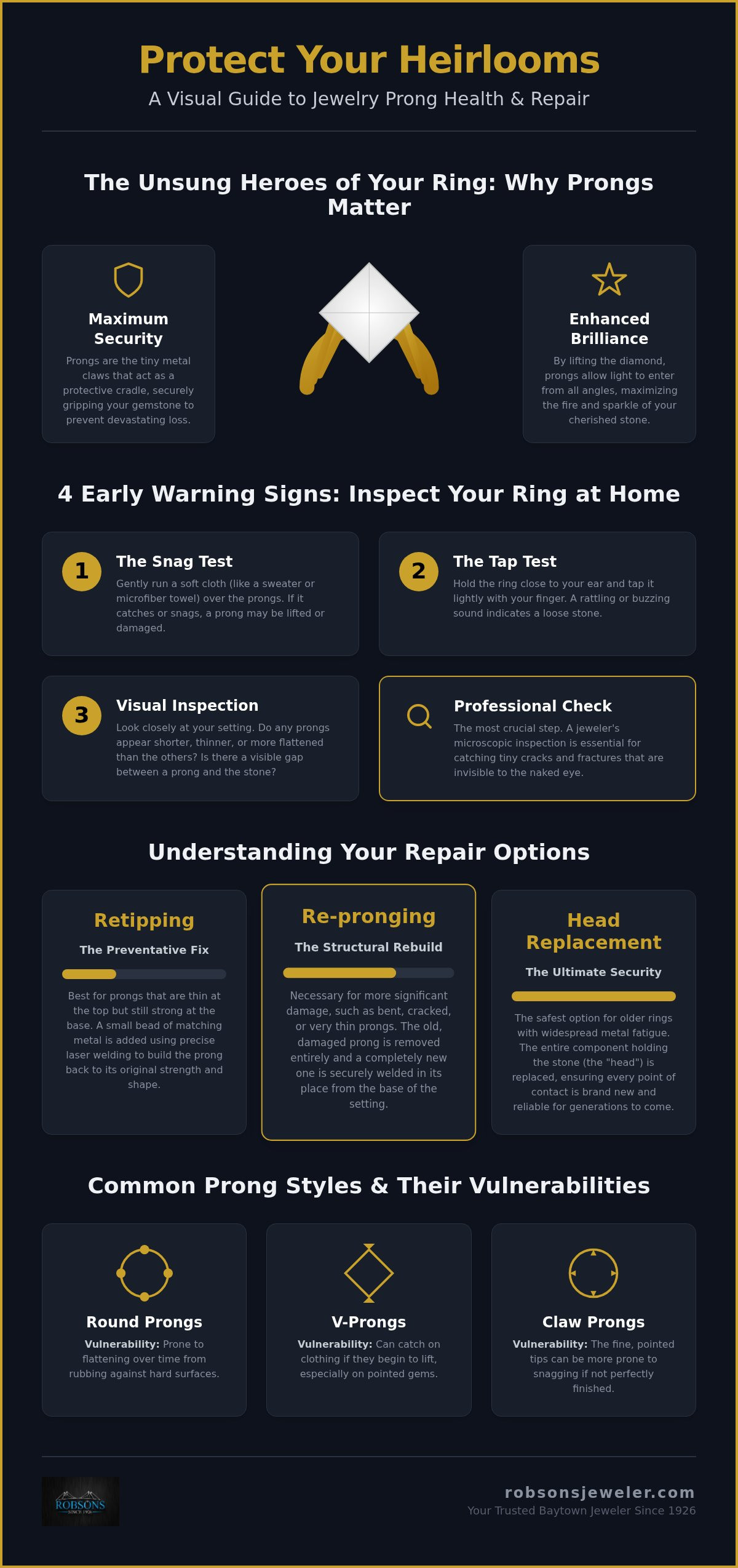
When you look at your ring, you likely focus on the brilliant center stone. However, the unsung heroes of your jewelry are the prongs. These are the small metal claws that secure a gemstone to the ring head, acting as a protective cradle for your diamond. Understanding the Anatomy of a Setting is the first step in recognizing when it's time for professional jewelry prong repair. These tiny components do more than just hold the stone; they elevate it. By lifting the diamond away from the band, prongs allow light to enter from all angles. This maximizes the fire and brilliance that couples look for in engagement rings Baytown TX residents cherish.
Most settings are crafted from platinum or 14k and 18k gold. While these precious metals are chosen for their beauty, they wear differently over decades of use. Platinum is incredibly dense. It tends to displace rather than wear away. Gold is slightly softer and can thin out over time. Every time you reach into a pocket, knock your hand against a desk, or grip a steering wheel, you are subjecting these metals to microscopic stress. This leads to metal fatigue. Over time, the prongs become brittle or thin, eventually losing their grip on your gemstone.
Common Prong Styles and Their Vulnerabilities
Every design offers a unique aesthetic, but each comes with specific maintenance needs. Round prongs are the industry standard because of their classic look. However, they are prone to flattening over time as they rub against hard surfaces. If your ring features a marquise or pear-shaped stone, you likely have V-Prongs. These are essential for protecting the vulnerable points of the gem, but they can catch on clothing if they begin to lift. Claw prongs provide a sophisticated, pointed look that covers less of the diamond. They can be more prone to snagging if the finish isn't perfectly smooth.
Why 'Good Enough' Isn't Enough for Heirloom Security
Waiting until a prong is completely gone is a risky game. The emotional cost of losing a diamond often far outweighs the preventative cost of a simple repair. When a prong weakens, the stone begins to rattle. This movement isn't just annoying; it's dangerous. A loose stone acts like a tiny saw, slowly chipping away at the diamond's girdle. For those focused on heirloom jewelry restoration, maintaining these settings is about more than aesthetics. It's about preserving a family legacy for the next generation. Investing in timely jewelry prong repair ensures that your ring remains as secure as the day you first put it on.
Retipping vs. Re-pronging: Understanding Your Repair Options
Choosing the right path for jewelry prong repair depends entirely on the current state of your setting. Our goal is always to provide the most secure environment for your stone while maintaining the aesthetic beauty of the piece. There are two primary techniques we use to restore a setting: retipping and re-pronging. Retipping involves adding a small bead of matching precious metal to the top of a worn prong to build it back up. Conversely, re-pronging, or complete prong replacement, involves removing the damaged prong entirely and welding a new one from the base of the setting.
If most of your prongs are compromised, we might suggest a full head replacement. This is often the safest route for older rings where the metal has become brittle throughout the entire structure. Rather than patching individual spots, replacing the "head," which is the component that holds the stone, ensures that every point of contact is brand new and reliable. This deep structural work is a specialty of our local jewelry repair shop, where we prioritize the long-term safety of your diamonds.
When Retipping is the Ideal Solution
Retipping is a wonderful preventative measure for jewelry that is just starting to show its age. It's the perfect choice when the prong has thinned at the top but remains thick and sturdy at the base. Modern technology has changed this process significantly. We often use laser welding, which allows us to direct intense, precise heat to a tiny area. This means we can perform the repair without exposing your entire diamond or gemstone to high temperatures. Before you bring your piece in, you can Inspect Your Ring at Home to see if the tips look flat, paper-thin, or uneven compared to the others.
The Necessity of Complete Prong Replacement
There are times when a simple patch isn't enough to guarantee security. If a prong has a deep crack at the base or if the tip has snapped off completely, re-pronging is necessary. This method provides a fresh start for the setting. Replacing all the prongs at once is frequently recommended because it ensures uniform strength across the entire ring. It also creates a cohesive look, as all the prongs will have the same height and thickness. This level of meticulous care is how we maintain the integrity of high-end pieces like those in our Modern Brilliance® Collection. If you're unsure which service your ring needs, a quick visit to our Baytown showroom can provide the clarity you need to move forward with confidence.
How to Inspect Your Ring at Home: 4 Warning Signs
You don't need a professional jeweler's loupe to spot potential trouble with your favorite pieces. Taking a few moments each month to perform a simple self-inspection can be the difference between a routine fix and losing a diamond. We encourage our neighbors in Baytown to treat these checks as a regular part of their jewelry care routine. By knowing what to look for, you can identify when jewelry prong repair becomes a priority.
The Snag Test: Grab a silk scarf or a fine-knit sweater. Gently run your ring across the fabric. If the metal catches or pulls a thread, a prong has likely lifted or developed a sharp, jagged edge.
The Tap Test: Hold your ring between two fingers close to your ear. Use a fingernail to gently tap the side of the gemstone. A faint clicking sound or a slight vibration indicates the stone is loose in its seat.
Visual Inspection: Look at your ring under a bright light with a basic magnifying glass. Check if the tips of the prongs look "pancaked" or flattened compared to when the ring was new.
The Gap Check: View the ring from the side. There should be no visible space between the metal prong and the surface of the diamond. If you see daylight, the stone is no longer held securely.
Tactile Clues: Beyond What You Can See
Sometimes your skin provides the first warning. If your ring starts scratching your skin or catching in your hair during your morning routine, it is a clear sign of wear. Snagging is the most reliable early warning sign of impending prong failure. While a prong might feel smooth to the touch, it could actually be dangerously thin. As the metal wears down, it loses the structural strength required to withstand a sudden bump against a hard surface. This thinning happens gradually, often going unnoticed until the metal finally snaps.
Visual Red Flags for Diamond Owners
When inspecting your setting, look for prongs that have lost their original rounded or pointed shape. "Pancaked" prongs are a common result of years of friction against clothing and surfaces. You should also look for "lifted" prongs that no longer make contact with the crown of the diamond. If even one prong is lifted, the others are under increased stress and are more likely to fail. Regular jewelry maintenance and cleaning removes the dirt and oils that can hide these subtle red flags, making it much easier to see the true condition of your metalwork. Keeping your jewelry clean ensures that you can spot these issues before they lead to a missing stone.
The Professional Prong Repair Process: From Intake to Polish
When you bring your ring into our Baytown showroom, the journey toward total security begins with a methodical, multi-step restoration. Professional jewelry prong repair is an art form that requires both high-tech precision and a master's touch. Our process is designed to be transparent, ensuring you feel like a partner in the preservation of your jewelry rather than just a customer. Every piece undergoes a rigorous protocol to return it to you in better-than-new condition.
Step 1: Microscopic Inspection. We start by placing your ring under a high-powered microscope. This allows us to identify hairline fractures and structural thinning that are invisible to the naked eye.
Step 2: Stone Protection. For heat-sensitive gems, we may remove the stone entirely or apply specialized heat-shielding gels. This protects the color and clarity of your gemstone during the repair.
Step 3: Metal Matching. We carefully select gold or platinum that perfectly matches the karat and color of your original setting. This ensures the repair is completely invisible once finished.
Step 4: Shaping and Polishing. After the new metal is added, we hand-file the prongs into the desired shape. A final high-speed polish restores the original design aesthetic and brilliant shine.
The Role of Modern Technology in Traditional Craft
While we value the heritage of our craft, we embrace the latest innovations to provide the best results. Laser welders are a game-changer in modern jewelry prong repair. Unlike traditional soldering, which heats the entire ring, a laser creates a concentrated beam that fuses metal at a molecular level. This creates a bond that is significantly stronger and cleaner. This technology is especially vital when working with both mined and lab-grown diamonds, as it allows us to reinforce the setting without stressing the stone. Many clients find that a professional ring resizing Baytown TX is the perfect time for a complimentary prong check to ensure everything remains secure.
Quality Control: The Final Security Check
Before any piece leaves our hands, it must pass a final stress test performed by our master jewelers. We use specialized tools to apply gentle pressure to each prong, verifying that the stone is perfectly seated and immobile. A final steam cleaning removes every trace of polishing compound, leaving your ring with a seamless, factory-fresh finish. This commitment to professional integrity is at the heart of Robson's legacy. We treat every repair with the same meticulous care we would give to our own family treasures. If you have noticed any of the warning signs mentioned earlier, visit Robson's Jewelers today for a professional consultation.
Why Local Expertise Matters for Your Jewelry Repair in Baytown
Choosing a partner for jewelry prong repair is a decision rooted in trust. While nationwide mail-in services offer a clinical convenience, they cannot replace the security of a face-to-face conversation. When you walk into a local showroom, you aren't just a tracking number; you're a neighbor. Entrusting a precious heirloom to the postal service carries a level of anxiety that simply doesn't exist when you hand your ring directly to a master jeweler you know by name. You deserve the peace of mind that comes from knowing your jewelry never leaves the safety of our care.
A primary advantage of local expertise is the one-on-one consultation. We don't just tell you that your prongs are worn; we show you. By looking through a jeweler’s loupe yourself, you can see the flattened tips or tiny fractures we have discussed in earlier sections. This transparency builds confidence. You will leave our store certain that your diamond is in capable hands rather than wondering about its status in a distant warehouse. Seeing the wear firsthand helps you understand exactly why a specific repair is necessary for your stone's safety.
A Century of Trust in the Baytown Area
Robson’s Jewelers has been a cornerstone of the community since 1926. For a century, we have served generations of families across Baytown, Mont Belvieu, and Dayton. This legacy isn't just about time; it's about the professional integrity required to stay in business for a hundred years. We have guided parents, children, and grandchildren through their most significant milestones. While we perform your inspection, you can relax at our unique Bracelet Bar. It is part of a showroom experience designed to make you feel like a guest, providing a relaxed environment while we care for your family treasures.
Beyond Prong Repair: A Full-Service Maintenance Hub
Our expertise extends far beyond simple fixes. We often integrate professional jewelry prong repair checks into our certified appraisals for insurance purposes, ensuring your documentation is as accurate as your setting is secure. For residents in Seabrook and La Porte, our local presence means quick, expert turnarounds without the stress of shipping. Supporting a family-owned business means you are investing back into the local craftsmanship that keeps our community vibrant. We treat every piece with the meticulous care it deserves. Visit Robson's Jewelers in Baytown for a complimentary prong inspection today and ensure your treasures are ready for the next generation.
Secure Your Legacy for the Generations to Come
Your jewelry is a beautiful collection of life's most precious moments. Protecting those memories starts with staying vigilant about the condition of your settings. By understanding the anatomy of your ring and performing regular at-home checks, you can prevent the heartbreak of a lost gemstone. Whether your piece requires a delicate retipping or a full structural rebuild, professional jewelry prong repair is the ultimate insurance policy for your favorite diamonds.
At Robson's Jewelers, we have been serving Baytown families since 1926. Our on-site master jewelers bring decades of expertise to every project, from contemporary styles in the Modern Brilliance® Collection to delicate family heirlooms. You shouldn't have to worry about the safety of your treasures when you work with a trusted local partner who treats your jewelry with meticulous care. We invite you to visit our showroom and let us help you keep your stones secure and sparkling for years to come.
Frequently Asked Questions
How much does jewelry prong repair typically cost?
The cost of jewelry prong repair depends on several factors, including the number of prongs that need attention and the type of precious metal involved. A single retip is a different process than a full head replacement. Because every piece is unique, we invite you to our Baytown showroom for a personalized consultation. We'll perform a microscopic inspection and provide a clear explanation of the work required.
How long does it take to retip a ring?
Most repairs are completed within a few business days, though times vary based on our current workshop schedule. Simple retipping on a single prong is faster than a full reconstruction of the setting. We prioritize meticulous care over speed to ensure your gemstone is perfectly secure. When you visit us, we'll provide a specific timeline based on the unique needs of your piece and our current volume.
Can I wear my ring if a prong is snagging on my clothes?
You should stop wearing your ring immediately if you notice snagging. This sensation indicates that a prong has lifted or developed a sharp edge, which means it's no longer providing full security for your stone. Continuing to wear the piece increases the risk of the prong snapping off entirely. Place the jewelry in a soft pouch and bring it in for a professional evaluation to prevent stone loss.
Is it better to retip a prong or replace the entire head?
Retipping is excellent for minor wear, but a full head replacement is often better for older rings with widespread metal fatigue. If multiple prongs are thin or brittle, replacing the entire component ensures uniform strength across the setting. This approach is more cost-effective in the long run because it prevents frequent return trips for individual repairs. We'll help you decide which path offers the best security.
Will my diamond be safe during the prong repair process?
Your gemstone is extremely safe in the hands of our master jewelers. We use advanced technology like laser welding to perform jewelry prong repair with pinpoint accuracy. This tool allows us to fuse metal without heating the entire stone, which is vital for protecting both mined and lab-grown diamonds. For particularly heat-sensitive gems, we may remove the stone entirely before working on the metal setting to ensure zero risk.
How often should I have my jewelry prongs inspected?
We recommend a professional inspection every six months for pieces you wear daily, such as engagement rings. Regular checks allow us to catch microscopic thinning or hairline fractures before they become structural failures. For jewelry worn only on special occasions, an annual check-up is usually sufficient. These brief visits provide peace of mind and ensure your precious items remain in showroom condition for decades to come.
Does insurance cover the cost of prong repair?
Most standard jewelry insurance policies cover the loss of a stone but don't usually cover preventative maintenance like jewelry prong repair. However, keeping your settings in good condition is often a requirement for maintaining your coverage. We can provide the necessary documentation and certified appraisals to help you navigate your policy requirements. It's always best to check with your specific provider regarding their maintenance and repair clauses.
Can you repair prongs on platinum and white gold rings?
Yes, we specialize in repairing prongs on all precious metals, including platinum and various karats of white gold. Platinum requires higher heat and a different technique than gold, while white gold often needs a fresh rhodium plating after the repair to restore its brilliant finish. Our craftsmen match the metal exactly to ensure the work is invisible. We treat every metal type with the specific technical care it requires.


Comments