


Oval Cut Diamonds in Mont Belvieu by Color and Clarity

An oval’s shape doesn’t tell you whether it’s natural or lab-grown: oval cut diamonds in Mont Belvieu can be either. The difference is their origin, not their outline, so consider both options when choosing a stone. Next, look at the diamond’s appearance and what its grading report tells you.
It’s natural to focus first on an oval diamond’s sparkle, shape, and size. This guide explains how cut and symmetry affect its appearance, how clarity and color shape what you see, and how carat weight and a grading report help you compare stones. You’ll have a clearer way to weigh natural and lab-grown diamonds and decide which details matter most for your ring.
Table of Contents
Are the oval engagement rings here lab-grown or natural?
Oval engagement rings can feature either a natural or lab-grown diamond. The oval outline identifies the shape, not the diamond’s origin. Compare origin separately from appearance, then consider how each stone’s cut, color, clarity, and carat weight suit your engagement ring.
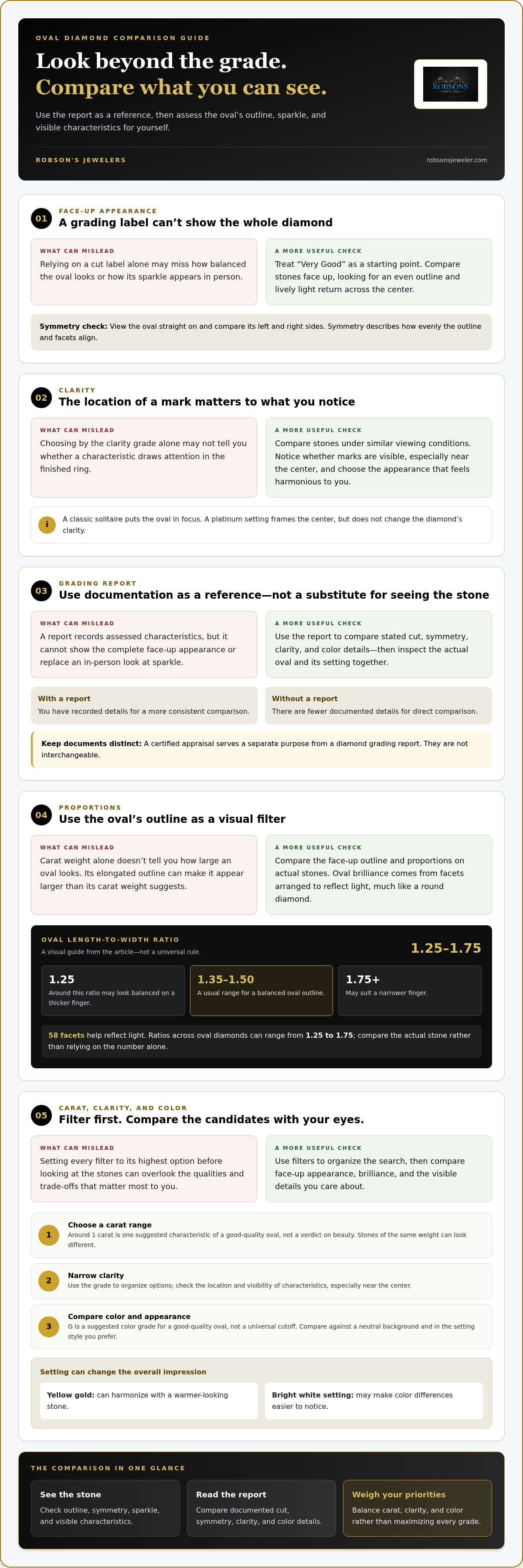
Oval brilliance comes from facets arranged to reflect light, much like a round diamond. Oval cuts have 58 facets, while their elongated outline can make a stone appear larger than its carat weight suggests. The shape can also elongate the appearance of a finger. For a balanced outline, a length-to-width ratio usually ranges from 1.35 to 1.50. Ratios across oval diamonds can range from 1.25 to 1.75. A narrower finger may suit a ratio of 1.75 or more, while a thicker finger may look balanced with a ratio around 1.25. Use these proportions as a visual filter, then compare actual stones.
Oval diamonds don’t have one fixed price relationship with round or other fancy cuts. Prices in Mont Belvieu depend on factors such as origin, carat weight, color, clarity, and cut quality. Compare stones with similar characteristics rather than judging by shape alone.
Online listings let you compare diamond details and images, but a screen can’t provide the same in-person view of sparkle and proportions. A local jeweler can let you examine how an oval appears from different angles. Custom design at Robson's Jewelers can also bring together an oval stone, ring setting, and preferred metal, such as rose gold.
For a diamond ring setting, look at how the prongs hold the oval’s ends and whether the stone sits securely. The setting should protect the tips while keeping the elongated shape visible. Return, warranty, resizing, and upgrade policies vary by store. Read the written terms before choosing, since they affect what happens after purchase.
Diamond symmetry, cut quality, clarity, and certification
For an oval engagement ring, judge the stone’s face-up appearance alongside its grading details. A “Very Good” cut rating is a useful starting point, but visual comparison still matters.
Symmetry, Cut Quality, and Clarity
Symmetry describes how evenly the oval’s outline and facets align. View the diamond straight on and compare its left and right sides for balance. Cut quality affects how light returns through the center, shaping the sparkle and elegance of the finished ring. Look for an even appearance rather than relying on one label alone.
Clarity describes visible internal or surface characteristics. Compare stones under similar viewing conditions, and note whether marks draw attention near the center. For example, a classic solitaire puts the oval in focus, while a platinum setting frames the center without changing the diamond’s clarity. Choose a stone whose appearance feels harmonious to you.
Certificates and Diamond Comparisons
A diamond certificate, also called a grading report, records a stone’s assessed characteristics. Use it to compare the stated cut, symmetry, clarity, and color details across oval diamonds. A report provides a consistent reference, but it doesn’t replace seeing the diamond’s sparkle and overall appearance in person.
When comparing stones with and without grading reports, consider how much documented information matters to your decision. Without a report, you have fewer recorded details for a direct comparison. Match stones by their listed characteristics, then inspect their face-up appearance. A round brilliant and an oval may reflect light differently, so compare stones within the shape you’re considering.
Keep a grading report distinct from a valuation document. A certified appraisal serves a separate purpose from a diamond grading report, so don’t treat the documents as interchangeable. For a final comparison, review the report and the actual stone together, including how its setting complements the oval’s outline.
Carat, clarity, and color filters
Start with carat as a sorting tool, not a verdict on beauty. Around 1 carat is one suggested characteristic of a good-quality oval, but two stones with the same weight can look different. Compare the face-up outline and brilliance, then decide whether the visible size suits your preferred setting. The elongated oval shape may spread its weight across a broad surface, so inspect the stone rather than choosing by carat alone.
Use clarity filters to narrow the field, then examine each candidate closely. A grade can help organize stones, but the location and visibility of characteristics affect what you notice. For example, a mark near the center may catch your eye more readily than one near the edge. Compare similar images or view stones under the same lighting. Choose clarity based on the appearance you want, not simply the highest available grade.
G is a suggested color grade for a good-quality oval. Treat it as a useful comparison point, not a universal cutoff. Look at the diamond against a neutral background, then consider how the metal changes the overall impression. A yellow-gold setting can harmonize with a warmer-looking stone, while a bright white setting may make color differences easier to notice. Compare the oval in the setting style you prefer.
Use a simple filter sequence: choose a carat range, narrow clarity, then compare color and appearance. Avoid setting every filter to its highest option before looking at the stones. A brilliant oval with balanced proportions may appeal more than a higher grade that doesn’t suit your priorities. Save a small group of candidates, compare their length and face-up appearance, and note which trade-offs matter most. This turns a long search into a focused choice, with each filter serving a clear purpose.
Diamond selection and the 4Cs
The 4Cs give you a practical framework for comparing oval engagement rings: cut, color, clarity, and carat. Oval diamonds are the second most desired shape after round brilliant cuts, but popularity won’t tell you which stone feels right. Start with the outline and light return, then weigh the grading details against your priorities. A beautiful diamond engagement ring balances these qualities rather than maximizing every grade.
Cut affects how the stone handles light, while symmetry helps its silhouette look balanced. Compare two oval stones face up, checking whether their outlines look even and their brilliance feels lively across the center. Then consider the setting: a solitaire keeps attention on the center stone, while side stones change the overall look. Think about how the diamond and setting work together, not as separate choices.
Color and clarity are most useful when judged by what you can see. Compare stones under similar lighting, noting whether a warmer tone or visible inclusion draws your eye. A yellow-gold setting can complement warmer color, while a white-metal setting may make color contrasts more noticeable. Clarity also depends on where characteristics sit: an inclusion near the center may stand out more than one near the edge. Use these observations to decide which trade-offs suit you.
Carat describes weight, not the complete face-up presence of an oval. Compare length, width, and outline alongside the number, then picture each stone in your preferred engagement setting. One oval may have a longer silhouette, while another looks broader across the finger. Choose the shape and proportions that enhance your intended design. For a focused comparison, explore loose mined and lab-grown diamonds and assess each option against the same four criteria.
Robson's Jewelers: Engagement Rings
Robson's Jewelers helps make choosing an oval diamond tangible with engagement rings, loose lab-grown diamonds, and custom jewelry design. Explore these options when you’ve narrowed your priorities and want to turn them into a ring design. Consider how an oval’s proportions pair with a setting and overall style, then create a custom design that reflects your preferences.
If you’re still comparing stones, consider the distinctions that matter most: natural or lab-grown origin, visible brilliance, color, clarity, and the look you want on the hand. Those choices can guide your plans for a finished ring or a loose lab-grown diamond. The goal is a considered selection, not a decision based on one grade alone.
Contact Robson's Jewelers or visit robsonsjeweler.com to explore oval engagement ring options.
Make Your Oval Choice Your Own
The right diamond should feel like part of a story you’re beginning, not simply a set of grades on a page. As you consider oval cut diamonds in Mont Belvieu, picture a design you’ll be glad to wear every day and the personal meaning you want it to hold. Bring your preferences together into one clear direction.
Robson's Jewelers offers engagement rings, jewelry repair, and custom jewelry design, giving you ways to mark a milestone, refresh a meaningful piece, or create something new. Decide which path fits what you have in mind, then explore how the details can come together in a piece that feels distinctly yours.
Contact Robson's Jewelers to explore oval diamonds and take the next step toward a ring that feels right for your story.
Frequently Asked Questions
Why Choose an Oval Cut Diamond?
An oval can suit someone who wants a distinctive center stone without choosing a sharp-cornered shape. Its outline pairs naturally with varied ring designs, from a simple solitaire to a setting with side stones. Consider the style you wear daily, then compare how the oval’s silhouette works with your preferred band and metal. The best fit is the one that feels harmonious with your taste.
Where can I buy oval cut diamonds near Mont Belvieu, Texas?
Robson's Jewelers in Baytown serves people looking for oval diamonds near Mont Belvieu. Its showroom is at 1120 W Baker Road, Baytown, TX 77521. The business serves Mont Belvieu and the greater East Houston area, including Crosby, Highlands, Pasadena, Deer Park, Channelview, Seabrook, Laport, and Dayton. You can explore loose mined or lab-grown diamonds and engagement rings for an in-person selection.
Which jewelry stores near Mont Belvieu sell oval diamond engagement rings?
Robson's Jewelers serves Mont Belvieu and the surrounding area, with engagement rings featuring natural and lab-grown diamonds. Its custom jewelry design service gives you a way to shape a ring around your preferred stone and setting. If you’re comparing oval diamond engagement rings, decide whether you want a ready-to-choose ring or prefer to create a design using a loose diamond.
What oval diamond cut, color, clarity, and carat grades offer the best value?
There isn’t one grade combination that guarantees the best value for every oval. First define what matters most: an appealing face-up appearance, a particular size impression, or a color that suits your chosen metal. Then compare stones with similar characteristics side by side. Value comes from the balance of qualities you can see and care about, not from selecting the highest grade in every category.
What diamond certification should I look for when buying an oval diamond?
Look for a grading report from a recognized independent gemological laboratory, with clear details about the specific diamond. Match the report’s identifying information to the stone and review its shape, measurements, and graded characteristics together. A report helps organize comparisons, but it doesn’t show how the diamond looks in your chosen setting. Consider the document alongside a direct view of the stone before deciding.
What are current prices for oval cut diamonds in the Mont Belvieu area?
Oval diamond prices in Mont Belvieu depend on origin, carat weight, color, clarity, and cut quality. Compare stones with similar characteristics rather than assuming the oval shape determines the price.
Comments