


Conflict Free Diamonds in Baytown: Meaning and Traceability

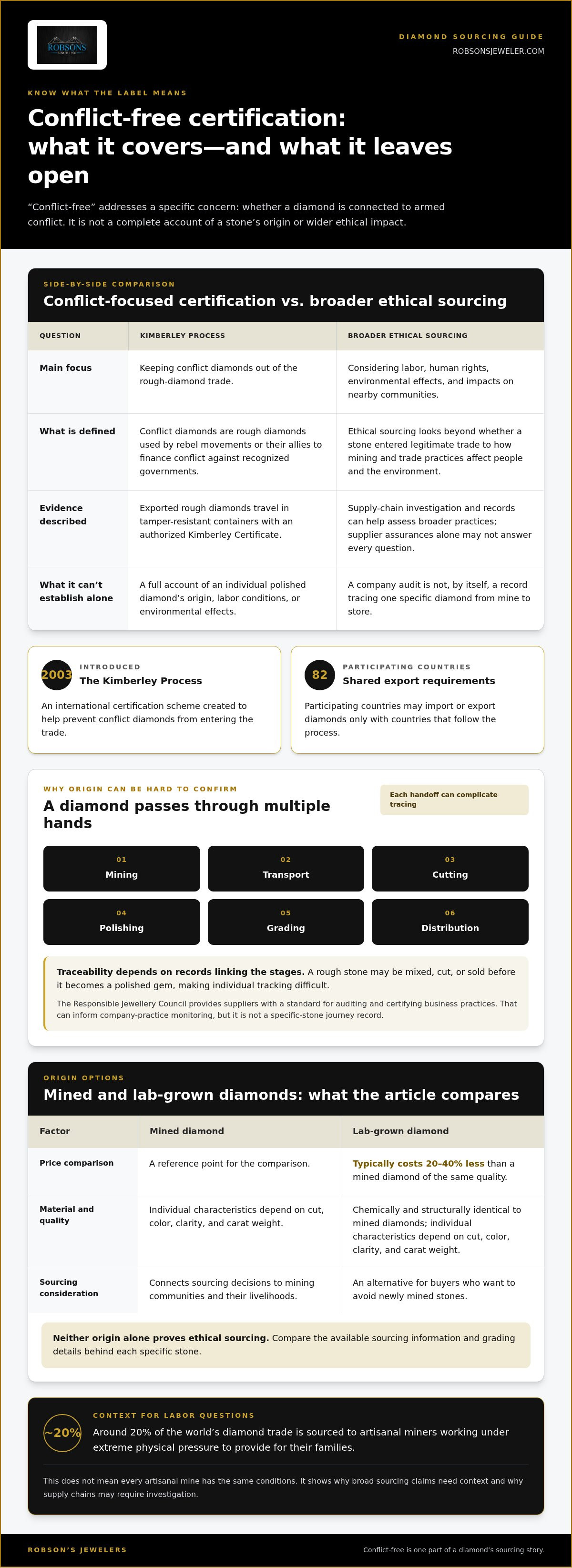
A conflict-free diamond is one that isn’t linked to armed conflict, but that label doesn’t answer every question about how it was mined or handled. The Kimberley Process Certification Scheme, introduced in 2003, was created to help prevent conflict diamonds from entering the trade. For people considering conflict-free diamonds in Baytown, the key distinction is that conflict-free describes a specific concern, not a complete account of a diamond’s origins or wider ethical impact.
It’s understandable to want a stone whose story feels as meaningful as the moment it marks. But “conflict-free,” “blood-free,” and “ethical” aren’t interchangeable promises, and certification doesn’t necessarily reveal every stage of a diamond’s journey.
This guide explains what the conflict-free standard covers, how it differs from broader ethical-sourcing claims, and why tracing a mined diamond can be challenging. You’ll also learn what origin information can and can’t tell you, and how Canadian-origin, inherited, and lab-grown diamonds fit into the bigger picture.
Table of Contents
What exactly is a conflict free diamond?
A conflict-free diamond is defined by whether it is connected to armed conflict, not by every detail of its origin. The Kimberley Process provides a global framework focused on keeping conflict diamonds out of trade.
The Kimberley Process and Conflict Diamonds
The Kimberley Process is an international certification scheme designed to help prevent conflict diamonds from entering the rough-diamond trade. Introduced in 2003, it involves 82 countries working to keep these stones out of the market. Conflict diamonds are mined in areas controlled by forces at war or in armed conflict with the region’s officially recognized government.
The World Diamond Council represents parts of the diamond industry in work connected with the Kimberley Process, while participating governments administer certification. For shoppers considering conflict-free diamonds in Baytown, this explains the scheme’s focus: conflict financing, not every labor, human-rights, or environmental issue associated with a stone.
Conflict-Free Definitions and Certification
Under the Kimberley Process definition, conflict diamonds are rough diamonds used by rebel movements or their allies to finance conflict against recognized governments. The certification scheme requires exported rough diamonds to travel in tamper-resistant containers with an authorized Kimberley Certificate. Participating countries may import or export diamonds only with countries that follow the process.
This framework sets shared export requirements, but it isn’t a complete ethical-sourcing guarantee. A certificate applies to rough-diamond shipments; it doesn’t provide a full account of an individual polished stone’s labor conditions, environmental effects, or path through later trading stages.
Checking a Diamond’s Certification
To assess conflict-free status, review sourcing documents that connect a rough-diamond shipment with an authorized Kimberley Certificate. The certificate supports compliance at export, but a diamond may pass through several later stages, making individual tracking difficult. When comparing conflict-free diamonds in Baytown, distinguish shipment certification from broader claims about a specific stone’s origin and treatment.
Which Baytown jewelers sell ethically sourced or Kimberley Process-certified diamonds? The Kimberley Process certifies rough-diamond shipments, not retailers, so the relevant detail is the sourcing documentation for the stone. How can you verify that a diamond is conflict-free? Review its shipment certificate and available traceability records, while remembering that Kimberley certification alone doesn’t establish broader ethical or environmental practices.
Meaning of conflict-free, blood-free, and ethical diamonds
“Conflict-free” refers to a diamond that isn’t associated with armed conflict, while “blood-free” is often used as a similar label. Neither term automatically describes wages, workplace safety, environmental effects, or community benefits. A stone can meet the conflict-focused standard yet leave other sourcing questions unanswered. Ethical sourcing considers a wider range of practices across mining and the diamond trade.
The Clean Diamond Trade Act aims to prohibit imports of diamonds whose mining fuels conflict in their country of origin, according to the United States Congress. That legal goal addresses conflict, not every labor or environmental concern. An ethical sourcing assessment therefore looks beyond whether stones entered legitimate trade and considers how mining affects workers and nearby communities.
Labor deserves particular attention in natural-diamond sourcing. Around 20% of the world’s diamond trade is sourced to artisanal miners working under extreme physical pressure to provide for their families. This doesn’t mean every artisanal mine has the same conditions; it shows why broad claims need context. Retailers seeking ethical labor should investigate supply chains rather than rely only on suppliers’ assurances. The same care applies when evaluating other ethically sourced gemstones.
How do lab-grown and natural conflict-free diamonds compare in price and quality? Lab-grown diamonds typically cost 20-40% less than mined diamonds of the same quality. Both are chemically and structurally identical, but each stone’s cut, color, clarity, and carat weight determine its individual characteristics.
Lab-grown diamonds offer an alternative for buyers who want to avoid newly mined stones, while natural diamonds connect sourcing decisions to mining communities and their livelihoods. Neither origin alone proves a diamond is ethically sourced. Compare the specific sourcing information and grading details behind each option, then decide which considerations matter most to you. For a direct comparison, explore loose lab-grown diamonds alongside mined stones.
Traceability across the diamond supply chain
A mined diamond can pass through mining, transport, cutting, polishing, grading, and distribution before reaching an engagement ring. Each handoff can make it harder to connect a finished stone with its origin.
Supply-Chain Traceability and Monitoring
Traceability means following a diamond’s movement and recorded origin through supply-chain stages. It matters because a rough stone may be mixed, cut, or sold before becoming a polished gem, making individual tracking difficult. Supply-chain transparency depends on records linking those stages, not on a broad claim about a supplier or country.
The Responsible Jewellery Council provides suppliers with an internationally recognized standard for auditing and certifying business practices. This can inform monitoring of a company’s practices, but it isn’t a record tracing a specific diamond from mine to store. Factory-audit transparency and stone-level traceability answer different questions, so treat them as complementary evidence.
Human-rights due diligence focuses on identifying and addressing risks such as abusive labor practices across the supply chain. Retailers seeking ethical labor should investigate their supply chains rather than rely only on supplier assurances. For a particular diamond, useful details include its known origin, documented handoffs, and the scope of any business-practice audits.
Questions About a Diamond’s Origin
Ask about a diamond’s origin and records to understand how much of its journey is documented. For an engagement ring, these questions can help distinguish a traceable stone from a general sourcing statement:
What country or mine is identified as the diamond’s origin?
Which supply-chain stages are documented from rough stone to finished diamond?
Do records identify this specific stone, or describe a supplier’s general practices?
What does any audit cover, including labor and human-rights risks?
Clear answers help you assess the available transparency without treating an audit as proof of a stone’s entire history. A responsible purchasing decision weighs origin records, documented handoffs, and the limits of each certification or audit.
Beyond Conflict Free diamond standard
A conflict-free claim addresses a narrow issue: whether diamonds are connected to armed conflict. Responsible sourcing also raises questions about human rights, working conditions, environmental effects, and benefits for mining communities. When choosing an engagement ring, consider these separately rather than assuming one label covers every part of a stone’s origin.
Look at what each standard actually evaluates. ISO 14001 is a set of standards for regulating environmental disruption from mineral extraction. Members of the United Nations Global Compact align their work with ten principles covering labor, anti-corruption, human rights, and the environment. These frameworks concern broader business practices, not automatic proof of one diamond’s complete history.
Country-of-origin claims can provide useful context, but they don’t answer every ethical question. Canada has strict diamond-sourcing guidelines, and Canadian diamonds contain an inscription in the stone. That inscription can help identify Canadian origin; by itself, it doesn’t describe every labor or environmental condition connected to mining.
Reused stones offer another consideration. Reusing or inheriting a diamond can reduce demand for newly mined diamonds, but its original ethical sourcing may remain difficult to establish. Heirloom diamonds can also be hard to trace because origin records may not follow them through generations. Distinguish what reuse changes today from what it can reveal about the past.
What risks or misleading claims should you watch for when shopping for conflict-free diamonds? Be wary of broad promises that present conflict-free status as proof of responsible labor, environmental care, or complete origin traceability. Compare each claim with the evidence it actually covers, such as a country inscription, documented sourcing information, or a stated environmental standard.
Choose the priorities that matter most to you, then compare sourcing details with those priorities in mind. Explore diamond choices as you consider what belongs in a lasting, meaningful piece.
Robson's Jewelers: Engagement Rings
Robson's Jewelers can help you connect diamond-sourcing questions with the engagement ring you’re considering. If you’re comparing mined and lab-grown stones, explore loose lab-grown diamonds and discuss how origin information fits your priorities. Custom jewelry design offers another way to shape a ring around your personal style.
Bring the questions that matter to you, such as what sourcing information accompanies a stone and what its records cover. Understanding the difference between conflict-free certification and broader ethical claims can help you make an informed choice without treating one label as proof of everything.
Contact Robson's Jewelers to discuss engagement rings and diamond options.
Choose a Diamond Story That Feels Right
The right choice is about more than a label. It’s also about the values you want your purchase to reflect and the meaning you hope the finished piece will carry through the years. As you compare conflict-free diamonds in Baytown, decide which sourcing details matter most, then consider how the diamond will fit the design and become part of your story.
Robson's Jewelers offers engagement rings and custom jewelry design to help bring your vision to life. Jewelry repair can also help care for a treasured piece over time. These practical services support choosing jewelry that marks a milestone and remains meaningful beyond it.
When you’re ready to discuss diamond options or a design, ask Robson's Jewelers about diamonds. Take your questions and priorities with you, and move forward with confidence in the choice that feels like yours.
Frequently Asked Questions
What is the Kimberley Process?
The Kimberley Process is an international scheme that sets certification rules for rough diamonds traded between participating countries. Its purpose is to help keep conflict diamonds out of legitimate trade. For shoppers, the key point is what the paperwork represents: it relates to a rough-diamond shipment, not necessarily a complete record of an individual polished stone’s journey.
What does the Kimberley Process certification cover, and what are its limitations?
Kimberley Process certification covers rough-diamond exports moving through participating countries under the scheme’s requirements. It doesn’t assess a diamond’s cut, color, clarity, or carat weight, and it isn’t a full audit of labor, human-rights, or environmental practices. For example, a certificate can address conflict-related trade while leaving separate questions about mining conditions unanswered.
Are there independent certifications for ethical diamond sourcing beyond the Kimberley Process?
Broader standards and audits can address business practices, but they don’t all certify an individual diamond’s full origin. The Responsible Jewellery Council offers suppliers an internationally recognized standard for auditing and certifying business practices. ISO 14001 concerns environmental disruption from mineral extraction, while the United Nations Global Compact’s ten principles cover areas including labor and human rights. Check what each standard evaluates before relying on its label.
Which Baytown jewelers sell ethically sourced or Kimberley Process-certified diamonds?
The Kimberley Process certifies rough-diamond shipments, not retailers. Ask for the stone’s sourcing documentation and available traceability records.



Comments