

Jewelry Insurance Appraisals: Complete Guide (2026)

That original sales receipt or diamond grading report tucked in your jewelry box will not replace your engagement ring if it is ever lost or stolen. Most homeowner's policies cap standard jewelry theft coverage at just $1,000 to $2,000, leaving cherished pieces severely underinsured as precious metal and diamond markets fluctuate. Securing official insurance appraisals for jewelry is the only reliable way to document true retail replacement cost, ensuring your insurer funds the precise craftsmanship and materials needed to recreate what you love.
We know how unnerving it feels to hand over sentimental heirlooms for evaluation, especially when sorting through the confusion of store receipts, lab grading paperwork, and official documents. Discover how certified jewelry appraisals protect your precious pieces, what insurers require, and how to safeguard your investment. This guide outlines the exact documentation carriers mandate, the credentials to look for in an appraiser, and the timeline for scheduling updates so your fine jewelry remains protected for generations to come.
Table of Contents
What Is a Jewelry Appraisal and Why Is It Needed?
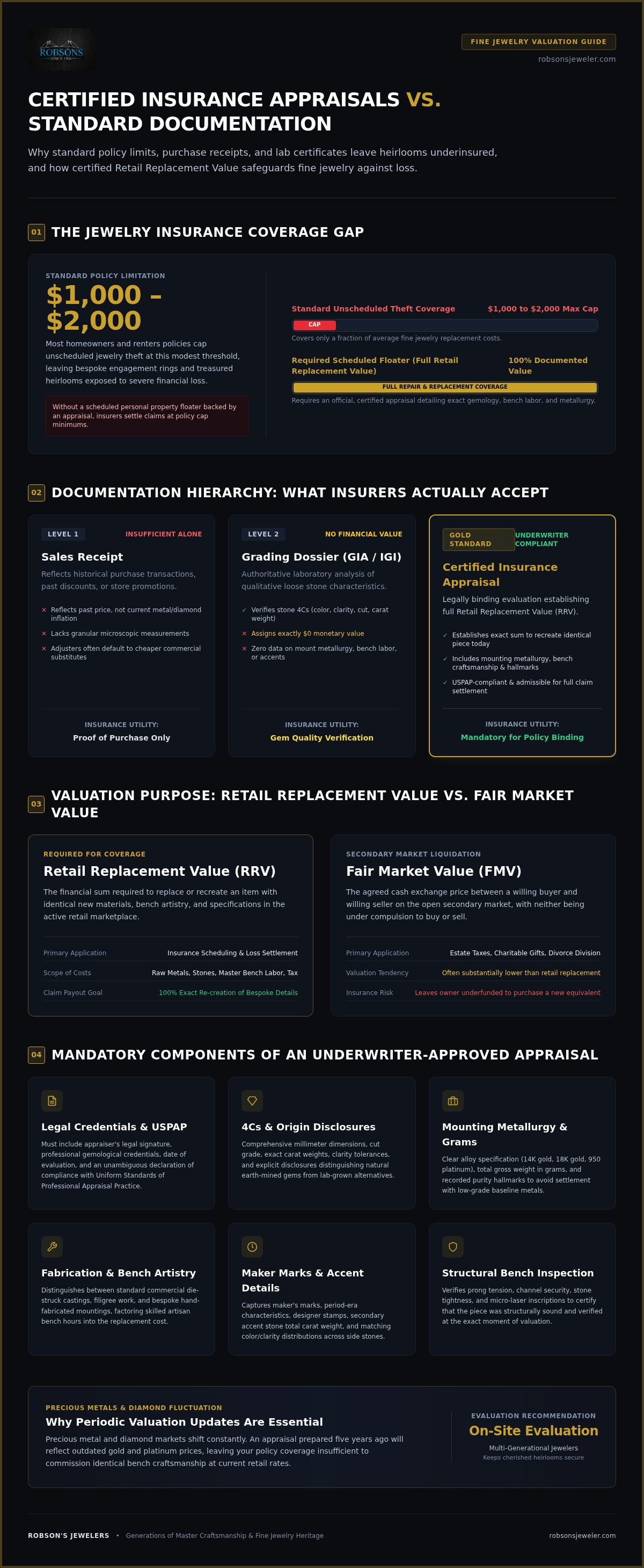
A certified jewelry appraisal is a formal, legally binding document that establishes the Retail Replacement Value of your fine jewelry. While standard homeowners and renters insurance covers general household belongings, unscheduled jewelry theft coverage is typically capped between $1,000 and $2,000. If your diamond ring, religious pendant, or heirloom piece exceeds that modest limit, you need a dedicated personal property floater. To bind that specific coverage, underwriters demand official insurance appraisals for jewelry to establish the exact financial sum required to recreate the piece in the current retail market.
As an authoritative form of personal property appraisal, this technical evaluation provides essential protection for bespoke custom jewelry designs, rare mined gemstones, and multi-generational family treasures. It translates intricate bench craftsmanship and sentimental history into definitive, court-admissible documentation that protects you against unexpected loss, theft, or catastrophic damage.
Insurance Appraisal vs. Diamond Grading Report
Many clients assume a laboratory dossier from the Gemological Institute of America (GIA) or International Gemological Institute (IGI) doubles as an insurance evaluation. It doesn't. A lab certificate identifies qualitative gemological characteristics, such as color grade, clarity, carat weight, and cut dimensions, but it assigns zero monetary value. Insurance adjusters cannot settle a replacement claim using only a grading dossier. A comprehensive appraisal incorporates that diamond analysis while evaluating the mounting metallurgy, accent stones, bench labor, and modern replacement pricing.
The Problem with Relying Exclusively on Sales Receipts
Sales receipts capture what you paid in the past, not what an identical item costs to recreate today. If you purchased an engagement ring several years ago or took advantage of a store promotion, that receipt reflects a discounted, historical transaction. Market shifts in gold, platinum, and diamonds quickly render paper receipts obsolete.
When an unexpected loss occurs, insurance adjusters review technical specifications rather than register printouts. Without an appraisal's granular measurements, metal purity stamps, and stone weights, carriers often default to lower-grade commercial alternatives. Securing updated insurance appraisals for jewelry ensures your settlement covers the full cost of identical materials, specific diamond clarities, and master craftsmanship.
Essential Components of an Insurance-Compliant Jewelry Appraisal
Insurance underwriters reject vague paperwork. A legally binding appraisal requires the appraiser's legal signature, certified credentials, date of evaluation, and a transparent methodology statement declaring compliance with the Uniform Standards of Professional Appraisal Practice (USPAP). Reviewing GIA's tips for jewelry appraisals highlights why this technical precision is essential; an incomplete document gives an insurer room to replace your diamond with a lower-grade alternative during a claim.
Detailed documentation protects you. If your appraisal lacks exact millimeter dimensions or purity hallmarks, an insurance claims adjuster might settle your loss using commercial-grade substitutes. Reliable insurance appraisals for jewelry eliminate that risk by providing an undeniable forensic record of your piece.
Gemological and Precious Metal Specifications
Precision matters. Your documentation must state the exact 4Cs for primary center stones, including millimeter dimensions, cut grade, and origin disclosures that separate mined gems from lab-grown alternatives. Secondary accents require total carat weights, color ranges, and clarity tolerances. Mountings must clearly list the precious metal alloy, whether 14K gold, 18K gold, or 950 platinum, alongside total gross weight in grams.
Mounting Integrity, Craftsmanship, and Provenance
Artistry drives replacement cost. A thorough appraisal records fabrication methods, distinguishing between standard die-struck castings, intricate filigree, and bespoke hand-fabricated mountings. Makers' marks, designer hallmarks, and period-era characteristics belong in this record. Experienced bench evaluators also inspect structural soundness, verifying prong tension and channel integrity to document that the piece was secure at the time of valuation.
Photographic Documentation and Laser Inscriptions
Visual verification closes every loophole. An insurer-accepted appraisal includes clear, multi-angle macro photographs that document:
Visible manufacturer hallmarks and metal purity stamps
Unique setting architecture, side profiles, and accent configurations
Microscopic laser inscriptions etched onto diamond girdles alongside matching laboratory report registry numbers
Having a secure, digital archive of this paperwork makes filing a policy endorsement effortless. If you want experienced professionals to document your fine bridal designs or inherited heirlooms, you can explore the certified appraisal process at Robson's Jewelers.
Retail Replacement Value vs. Fair Market Value: Key Differences
An insurance appraisal serves a fundamentally different purpose than an estate tax document or a resale evaluation. Retail Replacement Value estimates the current financial cost to purchase or custom-craft an identical new item from a traditional fine jeweler. Fair Market Value, by contrast, reflects the agreed price between a willing secondary buyer and seller, common in estate division, probate proceedings, or auction sales.
A common misunderstanding occurs when owners assume an insurance figure represents immediate resale or pawn value. Resale cash offers reflect used, secondary-market liquidation. Insurance appraisals for jewelry deliberately calculate retail dollars, guaranteeing you have the financial backing to replace a lost piece with pristine new materials.
Why Underwriters Demand Retail Replacement Value
Carriers require Retail Replacement Value to ensure you are made whole after a loss. If an accident happens, your policy funds the purchase of matching cut, color, and carat gems, along with current metal weights and jeweler bench fees.
This protection is vital for one-of-a-kind treasures. When rebuilding intricate mountings, such as those produced during custom jewelry design in Baytown, replacement costs include CAD modeling, casting, hand-setting, and artistic finishing. Following the ethical standards outlined in the FTC Jewelry Guides, professional appraisers detail these individual labor elements so your insurer never cuts corners on craftsmanship.
Impact of Market Fluctuations on Metals and Gems
Raw material markets shift constantly. Gold and platinum spot prices experience ongoing volatility, while fine rubies, sapphires, and emeralds steadily climb in rarity. Concurrently, market divergence between mined diamonds and loose lab-grown alternatives has transformed valuation benchmarks across the industry. An appraisal dated five years ago almost certainly leaves your mounting underinsured against modern metal spikes.
The Hazard of Over-Inflated Appraisals
Bigger numbers on an appraisal are not a benefit. Insurance carriers retain the contractual right to replace an item rather than pay out raw policy face value. If an appraiser artificially inflates a $5,000 heirloom to $10,000, you pay inflated annual premiums every year without gaining extra claim protection. Accurate insurance appraisals for jewelry establish realistic market figures, balancing fair premiums with ironclad coverage.
How to Prepare for an Appraisal and When to Update
Preparing for an evaluation involves gathering documentation and ensuring your jewelry is physically ready for close inspection. Choosing a credentialed local jeweler with recognized gemological training guarantees that your documentation meets strict underwriting criteria. Once the assessment is complete, forward the paperwork directly to your insurance agent so they can adjust your policy limits right away.
Scheduling regular insurance appraisals for jewelry prevents coverage gaps as precious metal and diamond markets evolve. A little foresight today protects your investment when you need it most.
Essential Documentation to Bring to Your Evaluation
Arriving prepared streamlines your appointment and provides your gemologist with valuable context. Make sure to bring:
Original diamond grading dossiers from the GIA, AGS, or IGI to confirm stone specifications and laser inscription numbers
Vintage sales slips, previous appraisals, or estate paperwork highlighting historical provenance and maker marks
Invoices for structural alterations or expert jewelry repair, ensuring recent retipping or shank reinforcements are recognized
Recommended Timeline for Updating Valuations
Jewelry values don't stand still. Most insurance carriers and gemological authorities recommend updating appraisals every three to five years. If your last evaluation was conducted before recent shifts in gold and platinum spot pricing, your coverage is likely lagging behind current replacement costs.
Immediate updates are essential after modifying a piece, adding side stones, or resetting a family diamond. Check your personal policy requirements, as some underwriters enforce specific re-evaluation deadlines to keep riders active.
Pre-Appraisal Inspection and Maintenance Checks
Your jewelry must be evaluated in sound physical condition. Built-up hand creams, soaps, and daily dust cling behind gem facets, altering how color and clarity appear under a microscope. Professional ultrasonic and steam cleaning strips away this residue so your gemologist views the stone's true optical traits.
Bench specialists also inspect delicate prongs, channels, and clasps. Catching a loose stone or thinning metal shank prior to final documentation protects the piece and guarantees the appraisal reflects a structurally pristine piece of fine jewelry. Ready to secure your valued pieces with updated documentation? Bring your collection to Robson's Jewelers to schedule your appraisal today.
Certified Jewelry Appraisals in Baytown: The Robson’s Jewelers Heritage
Handing over an inherited ring or a bespoke bridal set should never involve unnecessary risk. Shipping sentimental treasures through the mail to distant clearinghouses leaves clients anxious about transit accidents or misplacement. At Robson's Jewelers, every evaluation happens locally. We offer face-to-face consultations that keep your heirlooms safe inside our Baytown showroom while delivering the meticulous documentation insurance companies demand.
Our goal is straightforward: provide clear, accurate insurance appraisals for jewelry while treating your family milestones with genuine care. Combining technical gemological scrutiny with gentle cleaning and thorough prong checks, our team ensures your pieces leave our store pristine and completely protected.
Serving Baytown and East Harris County Since 1926
For nearly a century, our family-owned business has guided neighbors across Baytown, Mont Belvieu, Seabrook, La Porte, and Dayton through their most meaningful celebrations. That longevity brings deep institutional knowledge of regional underwriting expectations and personal property floaters. Whether you are preserving an Art Deco family ring or protecting a modern custom build, we handle your appraisal with verified expertise and time-honored ethics.
Comprehensive On-Site Evaluation for Fine Jewelry
Peace of mind comes from knowing exactly who is examining your valuables. We conduct complete on-site appraisals, inspecting everything from diamond girdles to precious metal purity under specialized magnification. This individualized care extends to bridal designs like those highlighted in our guide to engagement rings in Baytown, TX. We explain the findings clearly, walking you through carat weights, metal alloys, and prevailing market dynamics so you understand the valuation from top to bottom.
Protect Your Treasured Heirlooms and Bridal Rings
Don't wait for an unexpected mishap to find out whether your coverage falls short. Professional insurance appraisals for jewelry deliver the exact specifications your insurance broker needs to guarantee full financial recovery or flawless recreation. Stop by our showroom for a welcoming, neighborly consultation. We are here to answer your questions, inspect your settings, and help you safeguard the sentimental pieces that matter most to your family.
Protect Your Fine Jewelry for Generations to Come
Your fine jewelry embodies your most unforgettable milestones. Leaving those treasures vulnerable to shifting metal markets or standard policy limits is a risk you never have to take. While retail receipts capture past transactions, certified insurance appraisals for jewelry deliver the exacting gemological criteria and current Retail Replacement Value that insurance underwriters require for true peace of mind.
At Robson's Jewelers, our family has proudly served Baytown, Mont Belvieu, and our neighboring communities since 1926. You never have to worry about mailing delicate heirlooms away to unfamiliar clearinghouses. We provide secure, on-site gemological evaluations and comprehensive documentation tailored directly to your carrier's specifications. Best of all, every appraisal visit includes complete jewelry inspection, thorough cleaning, and careful prong checking to ensure your settings remain as sound as the day they were crafted.
Take a proactive step to safeguard your treasured pieces. Schedule your certified jewelry appraisal consultation with our team today and enjoy the confidence of knowing your legacy is thoroughly protected.
Frequently Asked Questions
How much does an insurance appraisal for jewelry cost?
Appraisal costs vary depending on the complexity of each item, the total number of gemstones, and the time required for gemological testing. Intricate vintage heirlooms with multiple accent stones or custom mountings take longer to evaluate than a classic solitaire engagement ring. Professional appraisers establish their rates based on the time and technical expertise involved in the evaluation rather than taking a percentage of the jewelry's overall value.
Is an appraisal the same as a GIA diamond certificate?
No, an appraisal is fundamentally different from a GIA diamond grading report. A GIA report grades individual physical traits, including color, clarity, carat weight, and cut dimensions, without assigning any monetary value. An appraisal uses those laboratory specifications alongside mounting metallurgy, accent stones, and current retail manufacturing costs to calculate the full Retail Replacement Value that insurance underwriters require to issue a policy.
Can I use a sales receipt instead of an appraisal for insurance?
A sales receipt is rarely sufficient for scheduled personal property coverage. Receipts only capture what you paid during a past transaction, often reflecting seasonal promotions, clearance pricing, or outdated metal markets. Underwriters require official insurance appraisals for jewelry because they provide the exhaustive gemological descriptions, millimeter measurements, and metallurgical analysis necessary to recreate the exact piece if an unexpected loss occurs.
How often should I update my jewelry insurance appraisal?
Most insurance carriers recommend updating your paperwork every three to five years. Ongoing market shifts in gold, platinum, and diamond pricing can quickly make older valuations inadequate, leaving you at risk of being underinsured. You should also request an immediate update whenever you alter a piece, upgrade a center stone, or complete custom restoration work at our Baytown showroom.
What happens if my jewelry is underinsured when I file a claim?
If an item is underinsured, the insurance settlement will cap out at the stated dollar limit on your policy schedule. When current retail replacement costs exceed that documented limit, you must pay the remaining balance out of pocket to recreate an identical piece. Keeping valuations current ensures your settlement covers prevailing retail bench labor, rising metal spot prices, and matching replacement diamonds.
Will my homeowners insurance cover my jewelry without an appraisal?
Standard homeowners and renters policies provide limited coverage for jewelry, but claims are strictly capped, typically between $1,000 and $2,000 for theft. Standard policies also exclude accidental loss, such as losing a ring while traveling. To secure comprehensive, worldwide coverage against theft, damage, and mysterious disappearance, you must schedule the item on a floater, which requires a certified appraisal.
Do I need an appraisal for lab-grown diamond jewelry?
Yes, lab-grown diamond jewelry requires documentation if you wish to insure it against loss, theft, or damage. While lab-created stones have distinct pricing structures from mined diamonds, the precious mounting, side stones, and custom bench craftsmanship still carry significant replacement value. Dedicated insurance appraisals for jewelry detail stone origins clearly, ensuring policyholders receive accurate replacement coverage tailored to their specific piece.


Comments