

IGI Certified Lab-Grown Diamonds: How to Read the Report and Choose with Confidence

What if the most detailed diamond report still can’t tell you which stone you’ll love most? When you’re comparing igi certified lab grown diamonds, an IGI report can bring welcome clarity: it documents a diamond’s lab-grown identity and grades its cut, color, clarity, and carat weight. It’s a useful guide, but it doesn’t guarantee that a diamond will look beautiful to you, hold its value, or suit your personal style.
It’s understandable to want clear information before choosing a stone for a meaningful piece of jewelry. This guide explains what an IGI report tells you, what it leaves to your judgment, and how to compare the 4Cs with a diamond’s appearance and your preferences. At Robson’s Jewelers, a family-owned Baytown jeweler, you can explore loose lab-grown diamonds and discuss how report details relate to the look and setting you have in mind.
Table of Contents
What Does IGI Certification Mean for a Lab-Grown Diamond?
An IGI report records a gemological laboratory’s assessment of a diamond’s characteristics, including its lab-grown origin and graded qualities. For someone considering igi certified lab grown diamonds, it provides a documented reference for understanding and comparing a stone. It does not decide whether that diamond is the right choice for you.
IGI certification is a laboratory-issued grading report that documents assessed diamond characteristics to help inform a purchase. It isn’t an appraisal, a promise of future resale value, or an endorsement that a particular stone is worth buying. The report makes details easier to compare, while your preferences and the diamond’s appearance remain part of the decision.
What does IGI stand for, and what does the report cover?
IGI stands for the International Gemological Institute (IGI), an organization that assesses and reports on diamonds. Its lab-grown diamond reports document the stone’s identified origin and graded characteristics, giving buyers and jewelry professionals a shared reference. A report describes the diamond; it doesn’t guarantee that you’ll love its appearance or that its asking price represents a particular value.
Think of the report as one part of an informed purchase. It gives you details to review and discuss, while an appraisal serves a different purpose: estimating value for a particular context. Neither document can decide which diamond best suits your taste, design, or budget.
Are lab-grown diamonds graded differently from mined diamonds?
Lab-grown describes a diamond’s origin, not a separate visual grading scale. IGI identifies the diamond as laboratory-grown, while its report uses familiar grading factors for both lab-grown and mined diamonds: cut, color, clarity, and carat weight. These describe distinct characteristics, so a strong grade in one doesn’t automatically mean the stone leads in another.
For example, two diamonds with the same carat weight may have different color or clarity grades and may look different to you. Origin alone doesn’t determine appearance, personal appeal, or value. Use the report to understand the recorded grades, then view the stone and consider how its qualities align with what you want.
That balance is useful when comparing reports. A grade makes a characteristic easier to discuss, but it can’t capture every aspect of how a diamond looks to your eye or feels in a setting. Treat the report as a starting point for an informed choice, not a substitute for your judgment.
How to Read an IGI Lab-Grown Diamond Report
Start with identity, then review the grades. Locate the report number and confirm that the document identifies the diamond as laboratory-grown. Use IGI’s current report lookup process to review the record, following the instructions on its official site. Then compare the report details with the stone you’re considering. The report number is a useful reference, but matching the paperwork to the actual diamond is essential.
IGI’s IGI Lab-Grown Diamond Reports page provides information about its reporting for lab-grown stones. Report layouts and included details can vary, so use the current report and lookup information rather than assuming every document shows identical fields. If measurements or proportions are listed, use them as added comparison context. They describe aspects of the stone’s dimensions and shape, but don’t replace seeing it for yourself.
What do cut, color, clarity, and carat tell you?
Each of the 4Cs describes a different quality. Cut relates to how well the diamond’s facets interact with light, influencing its brightness and sparkle. Color records the assessed color grade, while clarity reflects the presence and characteristics of internal features or surface blemishes under grading conditions. Your preferences help determine how much each grade matters to you.
Carat is a measure of weight, not a direct measurement of face-up size. Two diamonds with the same carat weight can have different measurements or proportions and may appear different in person. Read the 4Cs together: each grade describes one part of the diamond, and their combination gives a more useful comparison than any single score.
How can you verify and compare report details?
After matching the report to the stone, compare diamonds according to priorities you’ve already set. If you’re weighing two stones with similar carat weight, note where their cut, color, clarity, or listed measurements differ. Don’t assume one grade is automatically more important for every buyer. The right balance depends on your taste and what you notice when viewing the diamond.
Bring the report into the visual comparison. View each stone under the same conditions when possible, and notice which one appeals to you rather than choosing from grades alone. The report offers a consistent reference, but it can’t capture every personal preference. For an in-person conversation about loose lab-grown diamonds, explore diamonds with Robson’s Jewelers in Baytown and relate report details to the qualities you value.
What an IGI Report Proves, and What It Does Not
An IGI report can make important diamond characteristics easier to understand, but it isn’t a promise that a stone will look beautiful to every buyer or retain a particular value. For igi certified lab grown diamonds, the report is a documented assessment to support comparison, not a guarantee of investment performance or a fixed price. Keep that distinction in mind as you read its grades.
Does IGI certification guarantee a diamond’s quality or value?
A grading report records assessed characteristics; your response to a diamond’s appearance is personal. Two stones with similar grades may still appeal differently when viewed, and the same stone may look different to different people. Market value also depends on factors beyond a report, including market conditions and the terms of a particular sale. Certification supports comparison, but it doesn’t guarantee a specific price or predict resale outcomes.
Reports from different laboratories may use different formats or describe their grading scope differently. Compare the actual information on each report rather than treating a laboratory name as a ranking or assuming every document contains identical details.
Is an IGI report the same as a diamond appraisal?
No. A grading report assesses diamond characteristics. An appraisal is a separate valuation prepared for a stated purpose, such as insurance. The report alone doesn’t establish a replacement value or mean that an insurer will provide coverage. If you need documentation for insurance, ask what valuation information your insurer requires and keep the grading report as a separate reference.
The distinction matters after the purchase, too. A report helps identify and compare the stone’s documented qualities, while an appraisal addresses a valuation purpose. Neither should be treated as a promise of what a future buyer will pay. Read the report for what it states, then make your decision based on both the documented details and your priorities.
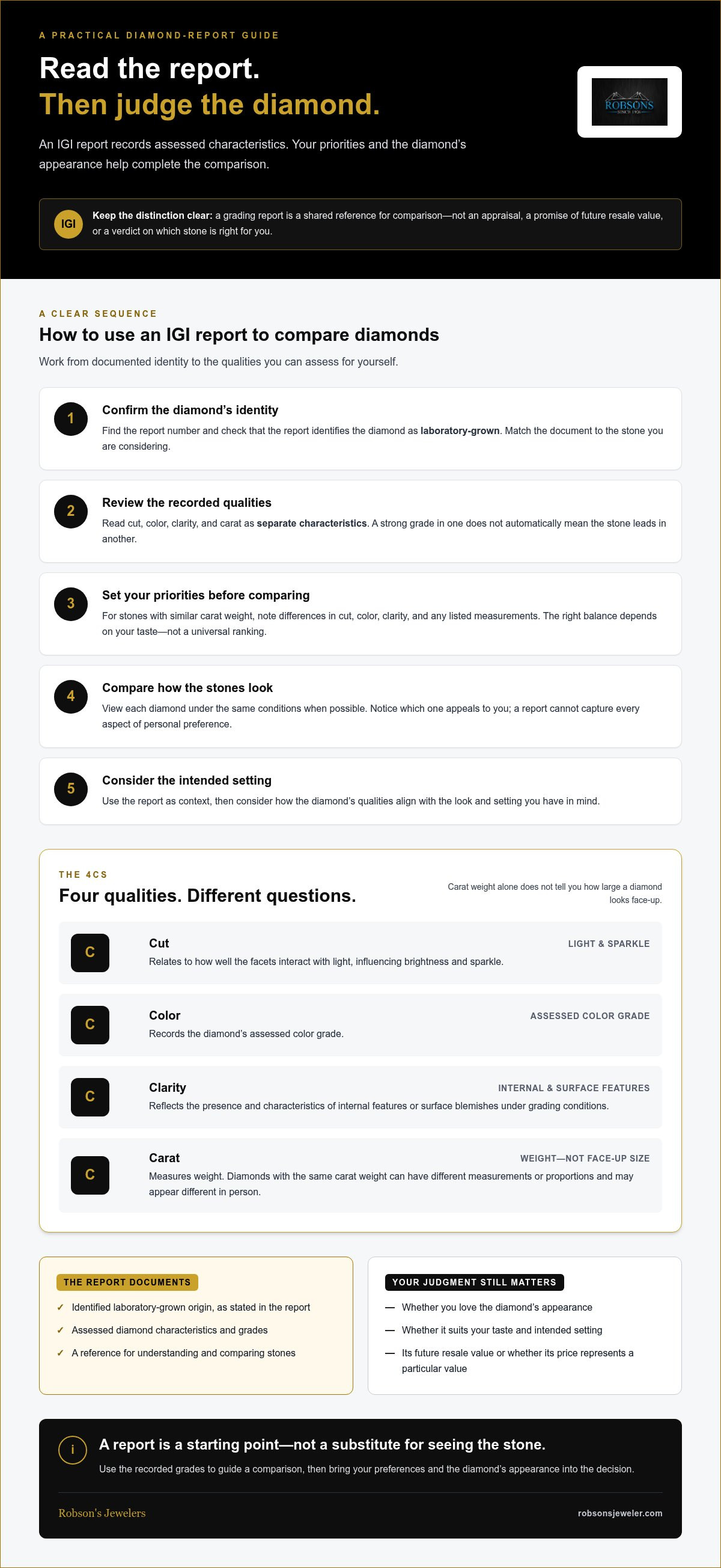
How to Use IGI Reports to Compare Lab-Grown Diamonds
Reports are most useful when they help you compare stones against priorities you’ve already chosen. Before comparing igi certified lab grown diamonds, decide what matters most to you: overall appearance, shape, carat weight, or how the diamond will look in a particular setting. There’s no single combination of grades that suits every buyer.
Which report details should you compare first?
Use this sequence to keep the process clear and consistent:
Confirm identity. Match the report details to the diamond, including its report number and laboratory-grown identification.
Set your preferences. Note the shapes and appearance you’re drawn to, along with how you picture the diamond in its intended setting.
Compare the 4Cs. Review cut-related information, color, clarity, and carat in light of your priorities. For stones with similar carat weight, look closely at how their other characteristics differ.
Review appearance. View the diamonds under consistent lighting when possible. This makes visual differences easier to notice alongside the grades, though lighting can’t represent every setting or environment where you’ll wear the stone.
Consider the setting. Compare the diamond’s shape and measurements with the style and proportions of the ring you have in mind.
Keep a short list of questions as you compare. If a report term or measurement isn’t clear, note it for discussion rather than treating one grade as a universal winner. A higher or lower grade in a particular category doesn’t automatically make a diamond right or wrong for your taste.
How should the report influence an engagement-ring choice?
For a ring, the report’s measurements and shape can help you consider how a diamond may relate to the setting’s proportions. The setting also contributes to the ring’s overall look, so consider the diamond and design together rather than choosing from report details alone. A stone viewed loose may make a different impression once paired with a setting and worn on the hand.
Compare the complete picture: report, appearance, and intended design. At Robson’s Jewelers in Baytown, you can discuss loose lab-grown diamonds and relate their documented details to your preferences. Explore loose lab-grown diamonds with Robson’s Jewelers.
Explore IGI Certified Lab-Grown Diamonds with Local Guidance in Baytown
A report gives you details to work with; a personal conversation can help connect those details to the diamond you want. As you explore igi certified lab grown diamonds, bring your preferences for shape, appearance, and setting, along with any report terms you’d like to understand. Comparing stones in person lets you consider documented characteristics alongside what catches your eye.
What can a local jeweler help you understand about an IGI report?
A jeweler can walk through report language with you and relate its details to your priorities. For example, you can discuss how a diamond’s shape and measurements may suit a setting, or compare the characteristics shown on different reports. Review the documentation for the specific diamond you’re considering. A helpful conversation clarifies your options while leaving the final choice to you.
Bring a few notes: which shapes appeal to you, how you imagine wearing the piece, and which report details have raised questions. That gives the conversation a useful starting point and keeps the comparison personal. If you’re new to loose stones, reviewing the steps in this guide can help you prepare to discuss what matters most.
How can you take the next step in Baytown?
Robson’s Jewelers is a family-owned Baytown jeweler. Its local history is distinct from the grading of any individual diamond: the report documents the assessed characteristics of a specific stone, while a jeweler can help you understand those details in relation to your preferences.
Robson’s Jewelers offers loose lab-grown diamonds and engagement rings, giving you the opportunity to consider a stone and the piece you envision together. Whether you’re beginning with a report or refining a setting idea, bring your questions and priorities to the conversation. Robson’s Jewelers welcomes customers from Baytown, Mont Belvieu, Seabrook, La Porte, and Dayton to explore loose lab-grown diamond options and discuss their next steps.
Make Your Diamond Choice with Clarity
An IGI report gives you a useful record of a diamond’s assessed characteristics, but it can’t choose the stone for you. Read the 4Cs together, verify that the report matches the diamond, and use the grades as a guide alongside your own impression of its appearance. A report supports comparison; it doesn’t promise beauty, resale value, or a particular price.
Bring your preferences and questions into the decision. Robson’s Jewelers is a family-owned independent jeweler in Baytown offering loose lab-grown and mined diamonds, engagement rings, and custom jewelry. A personal conversation can help connect the details on reports for igi certified lab grown diamonds with the look and setting you have in mind.
Frequently Asked Questions
What does IGI certified mean for a lab-grown diamond?
It means the International Gemological Institute has issued a report assessing the diamond’s characteristics and identifying it as laboratory-grown. IGI reports grade lab-grown diamonds using the 4Cs: cut, color, clarity, and carat weight. The report gives you documented details to review and compare, but it isn’t an endorsement of a purchase. Read it alongside your own visual impression and preferences before deciding which stone is right for you.
Are IGI certified lab-grown diamonds real diamonds?
Yes. Lab-grown diamonds are diamonds, not imitations such as cubic zirconia or moissanite. They share the essential physical, chemical, and optical properties of mined diamonds; the difference is their origin. An IGI report identifies that lab-grown origin and records assessed characteristics. Shared diamond identity doesn’t mean every stone looks the same. Cut, color, clarity, carat, and personal preference all shape your choice.
Is IGI certification reliable for lab-grown diamonds?
IGI provides an independent grading report that documents a lab-grown diamond’s assessed characteristics, giving buyers a useful reference for comparison. The report doesn’t predict whether you’ll love the diamond, guarantee a particular price, or settle every question about appearance. Check that it corresponds to the stone and review its details alongside the diamond itself. A jeweler can help explain report terminology in relation to your priorities.
What does an IGI lab-grown diamond report include?
An IGI lab-grown diamond report identifies the stone as laboratory-grown and records grading details, including the 4Cs: cut, color, clarity, and carat weight. Depending on the report, it may also show a report number and information such as measurements or proportions. Report formats and fields can vary, so use the document for the specific diamond you’re considering and consult IGI’s current information about its fields.
Does an IGI certificate guarantee a diamond’s value?
No. An IGI report documents assessed characteristics; it doesn’t guarantee the diamond’s retail price, future resale value, or investment performance. Market value depends on factors beyond the grades on the report, and a buyer’s personal sense of beauty can’t be captured by a score. Use the report to compare documented qualities, then consider the stone’s appearance and whether it fits your preferences. Treat it as a decision-making tool, not a financial promise.
How can I check whether an IGI diamond report is genuine?
Use IGI’s current report lookup process on its official website. Enter the report number as instructed, then compare the available record with the report you have and the diamond itself. Check that the lab-grown identification and listed characteristics correspond to the stone being presented. A matching online record is a helpful verification step, but it doesn’t replace looking at the diamond and ensuring the report belongs to that specific stone.


Comments