

Cushion Cut Diamonds in Dayton, TX: A Buyer’s Guide

A cushion diamond that looks dazzling in an online photo may feel quite different when you see its shape and sparkle in person. If you’re comparing cushion cut diamonds Dayton buyers can explore, look beyond carat weight and grading terms. Facet pattern, proportions, and how a stone sits in its setting all shape its character.
It can be difficult to judge similar options on a screen. This guide explains how to compare traditional chunky and crushed-ice appearances, assess the 4Cs with practical questions, and consider settings for your style and everyday wear. You’ll also learn what to check on grading reports and what to confirm about local availability before making a commitment. Robson’s Jewelers is a family-owned independent jeweler based in Baytown and serving Dayton and nearby communities, including Mont Belvieu, Seabrook, and La Porte. Specific cushion-cut inventory isn’t confirmed, so ask whether stones are currently available or can be sourced and how to arrange a viewing.
Table of Contents
What Makes a Cushion Cut Diamond Distinctive for Dayton Ring Shoppers?
A cushion cut diamond has a square or rectangular outline with softened, rounded corners, creating a pillow-like silhouette. The shape often feels romantic or vintage-inspired, but it can also suit a clean, contemporary ring. Its character comes from that balance, rather than from any one setting or era.
Shape describes a diamond’s outline; cut describes how its proportions and facets are fashioned to interact with light. The distinction matters because a cushion’s outline alone can’t tell you how bright or lively a particular stone will look. For a general overview of diamond cutting and its history, see Diamond cut.
How cushion shape and faceting affect its appearance
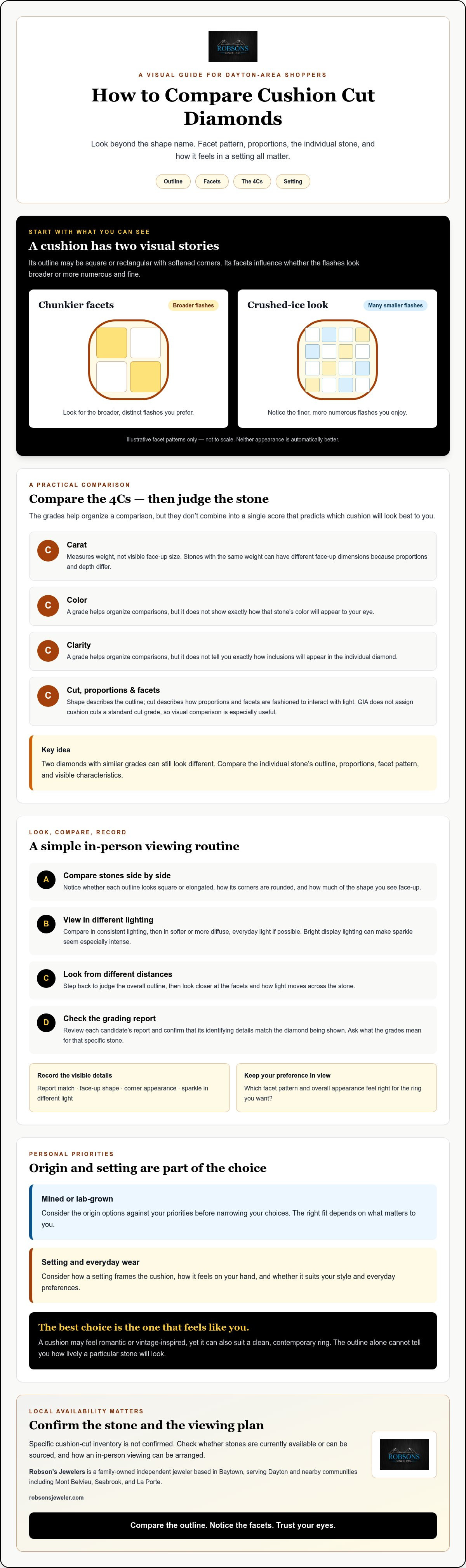
Some cushions appear nearly square, while others look longer and more rectangular. Facet patterns add another layer of character. Brilliant-style facets can create many smaller flashes, while chunkier facets tend to show broader flashes. Neither appearance is automatically better. The individual diamond, its proportions, and the light around it all affect what you see.
When possible, compare stones under more than one lighting condition. Bright display lighting can make sparkle seem especially intense, while softer or more diffuse light may show a different look. Also compare from different distances: step back to judge the overall outline, then look closer at the facets and how light moves across the stone. If two options seem similar, note which pattern you prefer rather than relying on terms such as “brilliant” or “crushed ice” alone.
Is a cushion cut the right style for your ring?
If you like softened edges and a romantic outline, a cushion may suit you better than a shape with sharper geometry, such as a princess or emerald cut. Think about the sparkle you enjoy most: a fine, lively shimmer or broader, distinct flashes. There’s no universal right answer. The best choice is the one that feels like you.
Stock photos can help you narrow your preferences, but they can’t show how a specific diamond performs in person. As you compare cushion cut diamonds Dayton buyers may consider with a local jeweler, view actual stones side by side when possible. Ask to compare their outlines, facet patterns, and appearance in ordinary viewing conditions. A direct comparison can turn a cut name into a clearer sense of the ring you want.
How to Compare Cushion Cut Diamond Quality Beyond the Shape
Carat, color, clarity, and cut each tell you something different. They work together, but they don’t create a single score that predicts which cushion will look best to you. The Gemological Institute of America (GIA) does not assign cushion cuts a standard cut grade, so visual comparison is especially useful for judging light performance and proportions. For background on the style’s origins and evolution, see GIA’s history of the cushion cut.
What the 4Cs can, and cannot, tell you
Carat measures weight, not the diamond’s visible size from above. Two stones with the same carat weight can have different face-up dimensions because their proportions and depth differ. Color and clarity grades help organize comparisons, but they don’t show exactly how a stone’s color or inclusions will appear to your eye.
Two diamonds with similar grades can look different because their proportions, facet patterns, and visible characteristics are not identical. Review the grading report for each candidate and check that its identifying details match the diamond being shown. Ask which report accompanies the stone and what its grades mean for that specific option. A loose-diamond guide can also help you become more familiar with grading and documentation before comparing individual stones.
How to assess shape, sparkle, and proportions in person
Compare candidate stones side by side. Note whether each looks elongated or square, how its corners are rounded, and how much of its outline you can see face-up. First compare them in consistent lighting, then view them in softer, everyday light if possible. Ask the jeweler to point out any visible inclusions or color characteristics and explain what you can see, without treating a grade as a guarantee of appearance.
A simple comparison list can keep the decision focused. For each diamond, record:
Report details: grading information and whether it matches the stone.
Face-up shape: outline, proportions, and corner appearance.
Sparkle: how the stone looks in more than one lighting condition.
Your priorities: the features you value most in a proposal ring.
As you evaluate cushion cut diamonds Dayton shoppers may explore, focus on the stone itself as well as its grades. Robson’s Jewelers is a family-owned independent jeweler based in Baytown and serving Dayton and nearby communities. You can explore diamond guidance and confirm how to arrange a consultation and view available options.
Mined or Lab-Grown Cushion Diamond: Which Option Fits Your Priorities?
A mined diamond and a lab-grown diamond have different origins, and that distinction can be an important part of choosing a ring. Rather than treating either option as the automatic choice, consider what matters most to you: origin, the individual stone’s appearance, grading documentation, and how each candidate fits your preferences.
Start by naming your priorities. You may want to understand how a diamond originated, focus on its face-up appearance, or compare stones with particular grading characteristics. Sharing those preferences with a jeweler can keep the discussion focused on what matters to you, rather than on a label alone.
Questions to ask when comparing diamond origins
Ask whether each diamond is mined or lab-grown and what documentation accompanies that specific stone. Check that the report details correspond to the diamond being presented, then consider the grading information alongside what you can see. Origin alone doesn’t tell you how a cushion’s outline, facets, or visible characteristics will appeal to you.
Useful questions include:
Origin: Is this diamond mined or lab-grown?
Documentation: What grading report, if any, accompanies this individual stone?
Appearance: How does its shape and sparkle compare with the other options?
Priorities: Which features can I be flexible about, and which matter most?
How to make a balanced comparison
Keep your notes consistent. For each candidate, record its origin, carat weight, color and clarity grades, report details, and visual impressions. View the stones under similar lighting where possible, then compare how they look in softer, everyday light. Using the same criteria for each candidate makes it easier to separate visible differences from details that appear only on paper.
A comparison framework can look like this:
Stone A: Origin, carat, color, clarity, report details, and notes on shape and sparkle.
Stone B: The same details, recorded in the same order.
Don’t let one grade or origin label stand in for the whole decision. Ask the jeweler to explain differences you notice and how the documentation relates to each stone. If you’re exploring cushion cut diamonds Dayton buyers may consider, Robson’s Jewelers offers loose mined and lab-grown diamonds, though specific cushion-cut availability should be confirmed. A fuller mined-versus-lab-grown guide can help you think through origin questions before comparing individual stones with a jeweler.
Choose a Cushion Diamond Setting for Your Style and Everyday Wear
A setting changes how a cushion diamond looks on the hand. A solitaire keeps attention on the center stone, while a halo surrounds it with a frame that can make the ring feel more ornate. Side stones add detail and visual width. Each style can complement a cushion’s softened corners, but the right choice depends on the individual diamond and the look you want.
Compare settings that complement cushion corners
Look at how the setting follows the diamond’s outline. Prong placement and band proportions should suit the specific stone’s measurements, not just its cut name. Ask how the corners will be secured and how the design affects the center stone’s visibility. No setting is automatically best for every wearer, so weigh its appearance alongside your preferences for daily use and care.
Match ring design to daily routines and personal taste
Think about your work, hobbies, and comfort preferences before narrowing the options. Do you use your hands often? Would you rather have a low-profile look or a more prominent center stone? Ask what routine maintenance the design may call for. Metal color, band width, and decorative details are personal choices, so try on comparable rings to see how each feels and looks on your hand.
For a one-of-a-kind ring, custom design can bring the stone’s proportions and your preferred details together. Robson’s Jewelers offers custom jewelry design, but the suitability of a particular setting depends on the specific diamond and should be discussed with the jeweler. A custom jewelry design guide can also help you prepare ideas and questions before a conversation.
As you compare cushion cut diamonds Dayton shoppers may consider, ask the jeweler to review the diamond’s measurements alongside the proposed setting. Discuss how the corners, prongs, band, and center stone will work together, and ask about care expectations rather than assuming any design is snag-proof or maintenance-free.
Ready to discuss a setting for your cushion diamond and everyday style? Explore custom jewelry design with Robson’s Jewelers, a family-owned jeweler based in Baytown and serving Dayton. Confirm how to arrange a consultation and review setting options.
Where to Explore Cushion Cut Diamonds Near Dayton, Texas
A useful consultation starts before you travel. First, decide what matters most: a square or elongated outline, a particular sparkle pattern, mined or lab-grown origin, and the setting style you’re considering. Then contact the jeweler to ask about current options. If suitable stones are available to view, compare their appearance and documentation, then discuss settings that fit the diamond’s measurements and your daily preferences.
Robson’s Jewelers is based in Baytown and lists Dayton within its service area. The store isn’t based in Dayton, so confirm how a consultation can be arranged and how you’ll view any options before making the trip. Cushion-cut availability, including whether a stone can be sourced, should be verified directly. Customers in Mont Belvieu, Seabrook, and La Porte can also confirm arrangements with the store.
A practical checklist for your Dayton-area diamond consultation
Bring a few reference images or notes, but use them as inspiration rather than expecting an exact match. A short checklist can help you make the most of a conversation:
Your preferred cushion shape and approximate proportions, such as square or elongated.
Setting inspiration, including details you like about the band or how the center stone is framed.
Questions about the specific diamond’s grading report and whether its details match the stone.
A request to compare more than one cushion diamond, if suitable options are available.
Confirmation of current availability, appointment details, and how viewing options will work before you travel.
Take notes as you compare. Keeping your priorities in view makes it easier to distinguish a diamond that simply looks attractive from one that fits your preferences for shape, sparkle, and setting.
Explore local and custom engagement-ring options
Robson’s Jewelers offers engagement rings, loose mined and lab-grown diamonds, and custom jewelry design. These are options to discuss, not confirmation that a particular cushion cut is in stock. Ask whether cushion-cut diamonds are currently available or can be sourced, what documentation accompanies each stone, and how the jeweler can help you review setting choices. For broader planning, an engagement-ring guide can help you think through how the center diamond and setting work together.
Choosing cushion cut diamonds Dayton buyers can compare is easier when practical details are clear before you commit. Robson’s is a family-owned jeweler based in Baytown, serving Dayton and nearby communities. Ask about current diamond options and the process for Dayton-area customers. Contact Robson’s Jewelers about diamond options and confirm availability and consultation arrangements before making the trip.
Take the Next Step Toward Your Ring
A cushion’s beauty is personal. Compare its outline and sparkle in person, review the grading details for the individual stone, and choose a setting that feels right for your style and daily routine. These practical checks can help cushion cut diamonds Dayton shoppers move from online research to a confident choice.
Robson’s Jewelers is a family-owned independent jeweler based in Baytown and serving Dayton, Mont Belvieu, Seabrook, and La Porte. The store offers engagement rings, loose mined and lab-grown diamonds, and custom jewelry design. Cushion-cut availability and consultation arrangements aren’t confirmed here, so check with the store before making the trip.
Explore engagement ring and diamond options with Robson’s Jewelers, and ask about current options, grading documentation, and how to arrange a consultation. Take your time comparing. The right ring is the one that brings your preferences together and feels meaningful for the promise it represents.
Frequently Asked Questions
Are cushion cut diamonds a good choice for an engagement ring?
Yes, a cushion cut can be a lovely engagement-ring choice if you’re drawn to softened corners and a blend of vintage character with flexible styling. Cushions can look square or elongated, and their facets may show fine sparkle or broader flashes. Compare the individual stone’s appearance and consider how its proportions work with your preferred setting and daily routine. The best choice is the one that suits your taste and feels comfortable to wear.
Do cushion cut diamonds look square or rectangular?
Cushion cut diamonds can look either square or rectangular, depending on the proportions of the individual stone. A square cushion has a more balanced outline, while an elongated cushion looks longer across the finger. Rounded corners soften both shapes. If you’re unsure which suits you, compare stones side by side and view each face-up. Don’t rely on a cut name or photograph alone, since proportions and presentation can affect how a diamond appears.
What should I look for when buying a cushion cut diamond?
Compare the diamond’s face-up outline, proportions, facet appearance, and visible sparkle, then review its carat, color, and clarity details. Ask what grading report accompanies that specific stone and confirm its identifying information matches the diamond. Cushion cuts don’t receive a standard GIA cut grade, so viewing the individual stone is especially useful. Consider your preferred setting, too, and ask how the diamond’s measurements relate to the design you have in mind.
Are lab-grown cushion cut diamonds real diamonds?
Yes, lab-grown cushion cut diamonds are real diamonds. They share the same chemical, physical, and optical properties as mined diamonds; their distinction is their origin. When comparing one, ask how it was grown and what grading documentation accompanies that particular stone. Then assess its appearance and grades alongside other options rather than choosing by origin alone. Your preference may depend on which characteristics matter most to you, including the diamond’s origin and appearance.
Does a cushion cut diamond sparkle as much as a round diamond?
A cushion diamond can show lively sparkle, but its light performance depends on the individual stone’s proportions and facet pattern. Some have a fine, brilliant-style appearance, while others show broader flashes. A round diamond and a cushion may display light differently, so a simple “more” or “less” comparison can be misleading. View the stones under similar lighting, then compare how each looks in softer, everyday light before deciding which sparkle you prefer.
Can I find cushion cut diamonds near Dayton, Texas?
Possibly, but confirm current cushion-cut availability before making a trip. Robson’s Jewelers is based in Baytown and lists Dayton within its service area. It also serves nearby communities including Mont Belvieu, Seabrook, and La Porte. Ask whether a cushion diamond is currently available or can be sourced, how to arrange a consultation, and how you can view the options. These checks help clarify the process before you travel.
Can a cushion cut diamond be used in a custom engagement ring?
Yes, a cushion cut can be considered for a custom engagement ring. The jeweler can discuss how the diamond’s measurements and rounded corners may work with your preferred setting and design details. Robson’s Jewelers offers custom jewelry design, along with engagement rings and loose mined and lab-grown diamonds. Confirm whether a suitable cushion stone is available or can be sourced, and ask what documentation accompanies it before settling on a design.


Comments